
The Most Common Vitamin Deficiencies in Women — And Their Silent Symptoms
Feeling exhausted, moody, or just "off" — and can't explain why? The answer might be hiding in your bloodwork.
Here's something many of us don't realise: you can have a vitamin deficiency for months — sometimes years — without knowing it. The symptoms are easy to wave off. A little tiredness here. Some hair thinning there. A low mood that you chalk up to stress.
But your body is actually whispering to you. And the whispers almost always start long before the louder warning signs kick in.
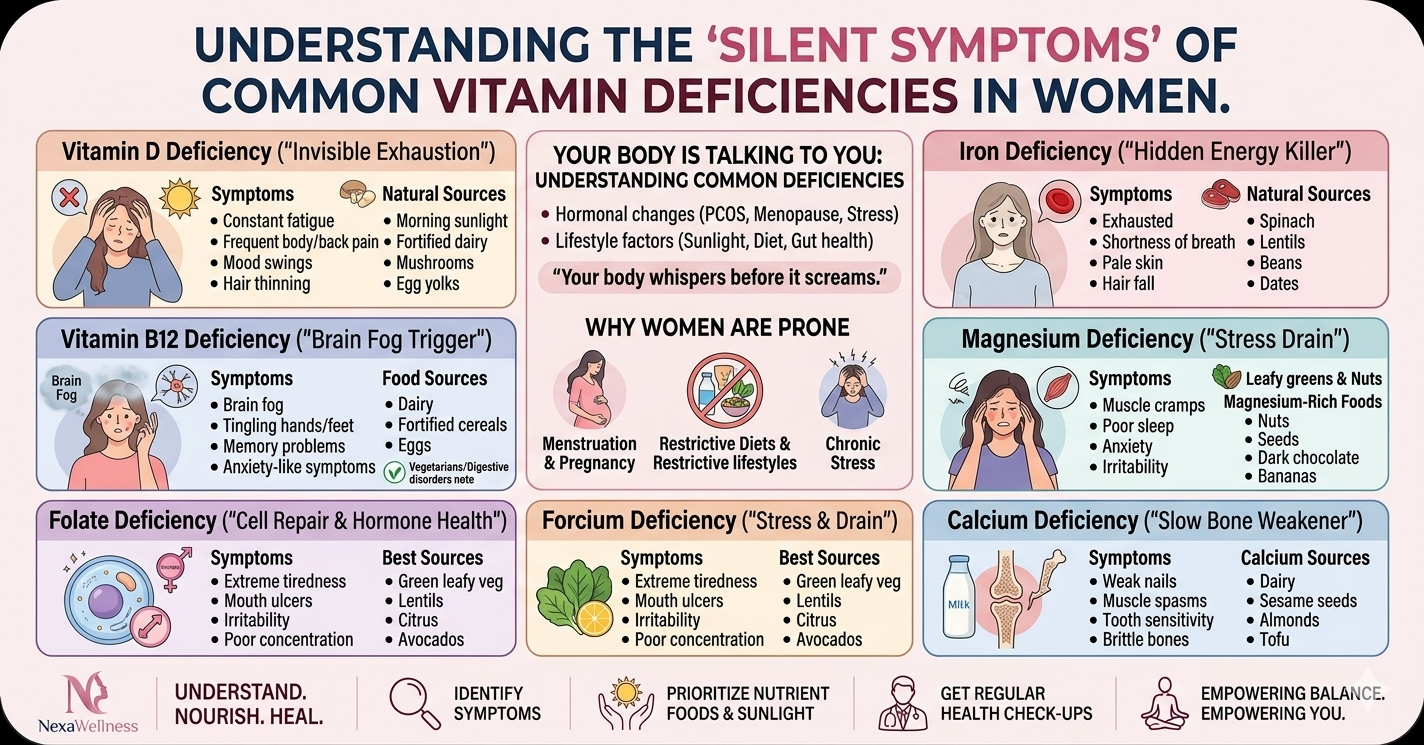
Women are especially vulnerable to certain deficiencies — due to menstruation, pregnancy, hormonal shifts, and the reality that many of us simply don't eat (or absorb) enough of what we need. This guide walks you through the seven most common vitamin and mineral deficiencies in women, what they quietly do to your body, and what you can do about them.
42%of women are vitamin D deficient
1 in 5women have iron-deficiency anaemia
90%don't get enough omega-3 or B12
The deficiencies
Iron
The energy stealer
Iron is responsible for making haemoglobin — the protein in red blood cells that carries oxygen around your body. When you're low on iron, your cells are essentially gasping for air, and everything slows down.
This is the most common deficiency in women of reproductive age, and it's largely driven by monthly blood loss. Even a relatively normal period can, over time, deplete your iron stores — especially if your diet doesn't replenish what's lost. Vegetarians and vegans face additional risk because plant-based iron (non-haem iron) is harder for the body to absorb than the iron found in meat.
Silent symptoms to watch for
Persistent fatigue, pale skin or inner eyelids, brittle nails, hair loss or thinning. Shortness of breath, difficulty concentrating, craving ice or dirt (pica), feeling cold all the time
Top food sources: Red meat, lentils, spinach, tofu, fortified cereals, and pumpkin seeds. Pair with vitamin C to boost absorption.
Vitamin D
The sunshine hormone
Vitamin D is technically a hormone, not just a vitamin — and it influences hundreds of processes in the body, from bone health and immune function to mood regulation and muscle strength. Despite its importance, deficiency is rampant: estimates suggest up to 40% of adults in sunny countries are still deficient, and the numbers are higher still in women who cover up outdoors or work all day indoors.
Darker skin tones require more sun exposure to produce the same amount of vitamin D, making deficiency especially prevalent among South Asian, African, and Middle Eastern women. If you're living above the 37th parallel (think the UK, Canada, northern US), your skin simply cannot make vitamin D from sunlight during autumn and winter months — regardless of how long you spend outdoors.
Silent symptoms to watch for
Low mood or depression, fatigue that sleep doesn't fix, bone or back pain, frequent infections, muscle weakness, hair loss, slow wound healing
Top food sources: Oily fish (salmon, mackerel), egg yolks, fortified dairy and plant milks. Most women need a supplement, especially Oct–March.
Vitamin B12
The nerve protector
B12 is essential for nerve function, DNA synthesis, and the production of red blood cells. It's found almost exclusively in animal products, which means vegans and vegetarians are at high risk unless they supplement. But it's not just a plant-based problem: many women also have reduced ability to absorb B12 from food due to low stomach acid (more common as we age), gut conditions like IBS or Crohn's disease, or the use of metformin (a common diabetes medication) or the contraceptive pill.
B12 deficiency builds very slowly — your body has stores that can last a couple of years, which is exactly why it's so insidious. By the time symptoms become obvious, the deficiency may have been progressing for a long time.
Silent symptoms to watch for
Tingling hands or feet, brain fog, fatigue, memory issues, mood changes or depression. Smooth or sore tongue, pale or jaundiced skin. Balance problems
Top food sources: Meat, fish, eggs, dairy, nutritional yeast, B12-fortified foods. Vegans should supplement — dietary sources alone won't cut it.
Folate (Vitamin B9)
The cell builder
Folate is crucial for cell division, red blood cell production, and — critically — foetal neural tube development in early pregnancy. You may have heard of it as "folic acid" in supplement form. Most women know it matters in pregnancy, but far fewer realise that folate deficiency can cause real problems outside of it too: anaemia, fatigue, and mood disruption are all common consequences.
The oral contraceptive pill is known to deplete folate levels, making women on long-term contraception a higher-risk group. Alcohol also interferes heavily with folate absorption.
Silent symptoms to watch for
Extreme tiredness, mouth ulcers, irritability or low mood, pale skin, heart palpitations, reduced sense of taste
Top food sources: Dark leafy greens, broccoli, chickpeas, lentils, avocado, eggs, fortified cereals. Women planning pregnancy should take 400 mcg of folic acid daily.
Magnesium
The calm mineral
Magnesium is involved in over 300 enzymatic reactions in the body — from energy production and blood sugar regulation to nerve signalling and muscle relaxation. It's also deeply tied to sleep quality and stress response. Most of us aren't getting nearly enough: modern diets high in processed foods and low in whole grains and leafy greens are to blame.
Women with PMS may find that magnesium deficiency is quietly amplifying their symptoms. Studies have found that low magnesium is associated with more severe menstrual cramps, mood swings, bloating, and headaches in the days before a period.
Silent symptoms to watch for
Muscle cramps or twitches, Poor sleep, Anxiety, Headaches or migraines, Worsened PMS, Constipation, Feeling stressed easily
Top food sources: Dark chocolate, almonds, spinach, avocado, cashews, black beans, and whole grains. Magnesium glycinate is a well-absorbed supplement form.
Iodine
The thyroid's fuel
The thyroid gland — that butterfly-shaped gland at the base of your neck — needs iodine to produce its hormones. And thyroid hormones control your metabolism, body temperature, heart rate, and energy levels. Iodine deficiency is the most common preventable cause of thyroid dysfunction worldwide.
It's particularly relevant for women because hypothyroidism (underactive thyroid) affects women at five to eight times the rate it affects men. Many women going dairy-free or eating primarily plant-based diets without careful planning end up low in iodine, since dairy products are the main dietary source in many countries (especially the UK).
Silent symptoms to watch for
Unexplained weight gain, fatigue, feeling cold, hair loss, brain fog, dry skin, swollen neck (goitre)
Top food sources: Seaweed, dairy products, eggs, white fish, iodised salt. Check your prenatal supplement includes iodine if pregnant.
Calcium & Vitamin K2
The bone duo
Calcium and vitamin K2 work as a team: calcium builds bone density, and K2 ensures the calcium goes to your bones (rather than accumulating in your arteries). Women are far more susceptible to osteoporosis than men, and bone loss often begins quietly in the 30s, accelerating sharply after menopause.
Most women know to think about calcium, but vitamin K2 remains dramatically overlooked — it's not found in many common foods, and it rarely makes it into standard multivitamins. Yet without K2, calcium supplementation may actually increase cardiovascular risk rather than help it.
Silent symptoms to watch for
Dental problems, muscle cramps, numbness or tingling, brittle nails, stress fractures, poor posture over time
Top food sources (calcium): Dairy, fortified plant milks, sardines, kale, broccoli. K2 sources: Natto, hard cheeses, egg yolks, grass-fed butter, fermented foods.
A note on absorption
It's not just what you eat — it's what your body can actually use. Gut health, medication use, age, and genetic variants can all affect absorption. Taking iron with vitamin C boosts uptake. Taking calcium with magnesium at the same time can reduce both. And fat-soluble vitamins like D and K2 need fat in the meal to be absorbed properly. Timing and pairing matter.
When to actually get tested
If you recognise several symptoms from the list above — especially if they've persisted for weeks or months — it's worth asking your doctor for a blood panel. A standard panel can check iron levels (including ferritin, which is the storage form), vitamin D, B12, folate, and thyroid function. Magnesium, iodine, and K2 are less routinely tested but can be requested.
A few things to know before you go: serum B12 tests can miss functional deficiency — some doctors now also check homocysteine or methylmalonic acid for a fuller picture. Ferritin is a better marker of iron stores than serum iron alone, and it's worth asking for it specifically
Share this post
Comments (0)
No comments yet. Be the first to comment!