
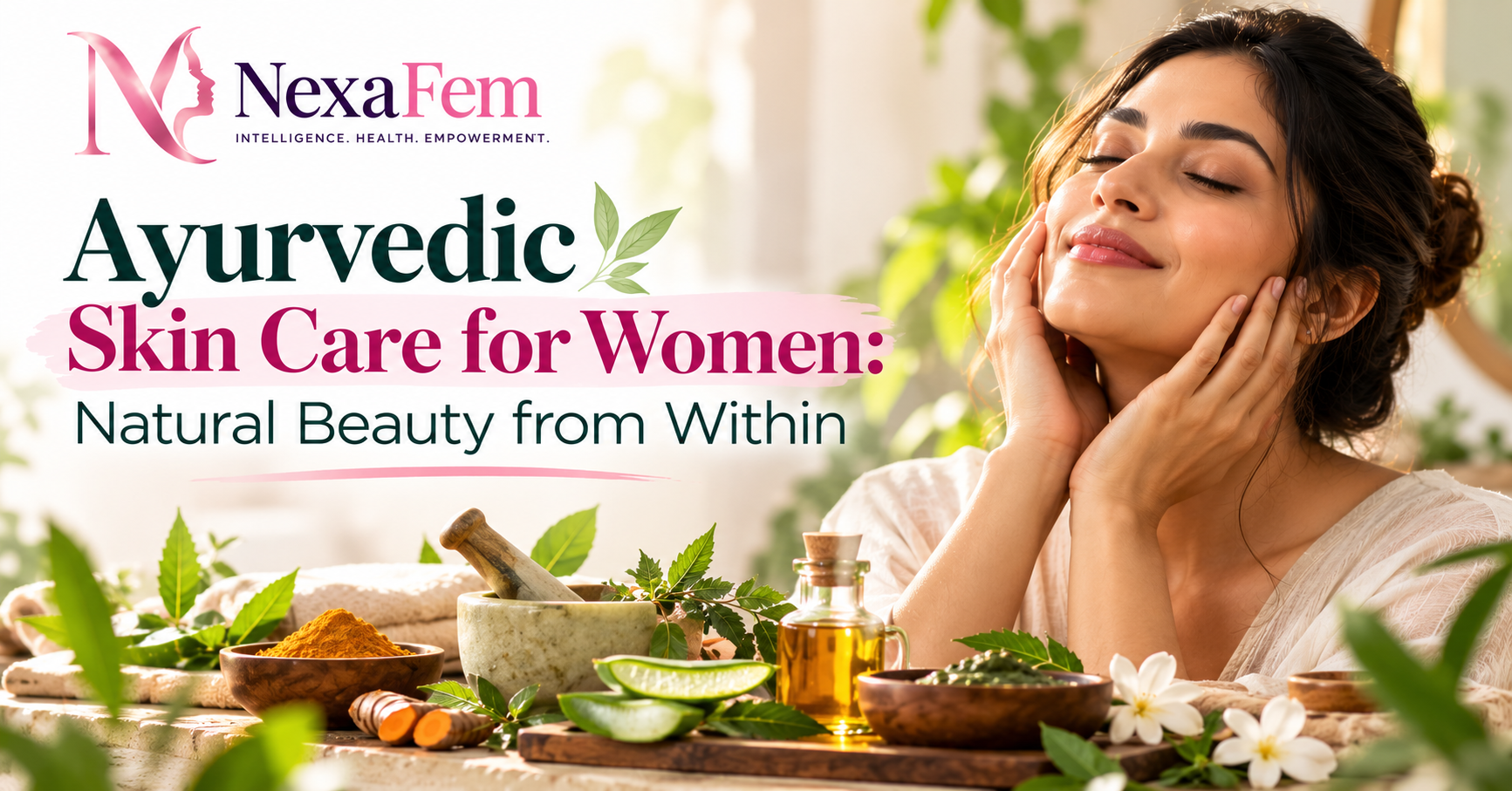
Ayurvedic Skin Care for Women: Natural Beauty from Within
Discover Ayurvedic skin care for women with practical tips on nutrition, gentle routines, herbs, sun protection and healthy skin from within.
Healthy skin is rarely about one miracle ingredient.
Your skin reflects many parts of everyday life: genetics, age, sun exposure, hormones, nutrition, sleep, stress, medications, climate and the products you use. That is one reason the Ayurvedic approach to beauty can feel intuitive. Rather than focusing only on the surface, Ayurveda traditionally considers skin in the context of the person's overall diet, lifestyle, routine and wellbeing.
But there is an important distinction between Ayurvedic tradition and modern dermatological evidence.
Some Ayurvedic principles—such as gentle self-care, nourishing food, regular routines and attention to stress and sleep—fit naturally alongside modern skin-health advice. Other practices, especially concentrated herbal products and homemade preparations, require more caution because evidence and product safety can vary.
So what does responsible Ayurvedic skin care look like today?
It means respecting traditional knowledge without promising that a particular herb, oil or ritual can cure a skin condition. It means supporting the skin barrier, protecting against UV exposure, eating well, sleeping adequately and choosing products that your skin actually tolerates.
In other words, natural beauty from within is not about chasing flawless skin. It is about creating conditions in which healthy skin can thrive.
Quick Summary
Ayurvedic skin care for women combines traditional principles of diet, lifestyle, daily routine and external care with an individualized approach to wellbeing.
Healthy skin also depends on modern fundamentals such as gentle cleansing, moisturization and broad-spectrum sun protection.
Foods rich in protein, vitamins, minerals, healthy fats and antioxidants can support overall skin health, but no single food guarantees glowing skin.
Ayurvedic ingredients such as turmeric, aloe vera and certain oils have traditional uses and some early research, but evidence varies by ingredient, preparation and skin condition.
"Natural" does not automatically mean safe. Patch testing, product quality, pregnancy considerations, medication interactions and professional dermatological advice all matter.
What Is Ayurvedic Skin Care?
Ayurvedic skin care is a traditional approach to skin and beauty that considers external skin care alongside diet, lifestyle, daily routine and overall wellbeing. Traditional Ayurvedic practices may include oil application, herbal ingredients, dietary practices and individualized approaches based on concepts such as Prakriti and Dosha.
Modern evidence does not establish every traditional Ayurvedic practice as an effective treatment for skin disease.
That distinction is important.
Ayurveda can provide a culturally meaningful framework for self-care, but acne, eczema, psoriasis, rosacea, melasma, infections and suspicious skin lesions are medical conditions that may require diagnosis and evidence-based treatment.
Ayurveda's Perspective on Healthy Skin
In Ayurveda, skin is traditionally viewed as connected with the body's broader state of health.
Classical concepts may consider factors including:
Prakriti — an individual's constitution
Doshas — Vata, Pitta and Kapha
Diet and digestion
Daily routine
Sleep
Seasonal changes
Emotional wellbeing
External skin care
Ayurvedic traditions may describe different skin tendencies using Dosha-related language. For example, dry or rough characteristics may be associated traditionally with Vata, while heat or redness may be discussed in relation to Pitta.
These descriptions are part of the Ayurvedic framework. They should not be confused with modern dermatological diagnoses.
Traditional Ayurvedic perspective
Ayurveda generally emphasizes individualized care rather than assuming every woman's skin needs the same routine.
What modern evidence says
Modern dermatology also recognizes that skincare should be adapted to skin type, age, environmental exposure and specific conditions.
Dermatologists generally emphasize a relatively simple foundation: gentle cleansing, appropriate moisturization and daily broad-spectrum sunscreen rather than constantly adding products. [1]
Practical takeaway
You can borrow the Ayurvedic principle of individualized, consistent self-care without assuming that a Dosha label can diagnose a skin disorder.
1. Start With the Skin Barrier
Before thinking about elaborate Ayurvedic masks or herbal ingredients, take care of your skin barrier.
The outer layer of skin helps reduce water loss and protects against environmental irritants. Excessive washing, harsh scrubs, strong fragrances and over-exfoliation can make sensitive or dry skin more uncomfortable.
A simple routine can be enough:
Morning
Gentle cleanser, if needed
Moisturizer suited to your skin
Broad-spectrum sunscreen
Evening
Gentle cleansing
Treatment product if medically or dermatologically appropriate
Moisturizer
The American Academy of Dermatology recommends gentle, non-abrasive cleansing and advises avoiding aggressive scrubbing because it can irritate the skin. [1][2]
This is an area where simplicity is often more useful than complexity.
2. Abhyanga: The Ayurvedic Oil Tradition
Abhyanga is an Ayurvedic practice involving oil application and massage.
Oil massage has a long history in Indian wellness traditions and may be used as part of self-care for the body.
From a modern perspective, gentle massage can feel relaxing, and an appropriate emollient can reduce dryness by helping support the skin's moisture barrier.
But claims should remain realistic.
Abhyanga should not be presented as a proven treatment for:
Acne
Eczema
Psoriasis
Hyperpigmentation
Wrinkles
Scarring
Skin infections
Traditional Ayurvedic perspective
Oil application is traditionally associated with nourishment, softness, routine and balance.
What modern evidence says
Evidence for massage itself is different from evidence that a particular Ayurvedic oil treats a specific dermatological disease. The latter requires condition-specific clinical research.
Practical takeaway
If you enjoy oil massage and your skin tolerates it, it can be a comfort-focused self-care practice. Choose a product appropriate for your skin and avoid applying oils to infected, broken or significantly inflamed skin.
If you have acne-prone facial skin, remember that some oils may feel heavy or contribute to breakouts in some individuals.
3. Turmeric: A Traditional Ingredient With Emerging Evidence
Few Indian ingredients are as strongly associated with traditional beauty practices as turmeric (Curcuma longa).
Turmeric and its active component, curcumin, have antioxidant and anti-inflammatory properties that have attracted dermatological research.
A systematic review of clinical studies found early evidence for potential benefits of topical and oral turmeric/curcumin in several skin conditions, but the authors emphasized that the evidence base was limited and further research was needed. [3]
A later systematic review identified randomized trials investigating curcumin in conditions including psoriasis, radiation dermatitis, pruritus, vitiligo, facial redness and scarring. The strength of evidence differed substantially between conditions. [4]
Traditional Ayurvedic perspective
Turmeric has a long history of use in Indian traditional medicine and cultural skincare practices.
What modern evidence says
There is interesting but condition-specific evidence, not proof that turmeric produces universally clearer or brighter skin.
Practical takeaway
Turmeric can be part of a normal diet and is a culturally relevant ingredient, but rubbing raw turmeric paste on the face is not automatically appropriate for everyone.
It can temporarily stain skin and may irritate some people.
If using a topical turmeric product, choose a properly formulated product and test it cautiously rather than assuming that "natural" means non-irritating.
4. Aloe Vera: Soothing Does Not Mean Curative
Aloe vera is another familiar ingredient in Indian and global skincare.
Aloe-based products are commonly used for their soothing and moisturizing qualities.
However, commercial aloe products vary significantly in formulation and concentration.
Traditional perspective
Aloe has traditionally been used externally in various forms for skin-related purposes.
Modern evidence
Research has investigated aloe for several skin conditions, but evidence varies according to the condition and formulation. Traditional use alone does not establish effectiveness for every dermatological problem.
Practical takeaway
If you use aloe vera, choose a reputable topical product, avoid applying it to significant wounds unless medically advised, and stop if it causes burning, itching or redness.
5. Neem and Other Ayurvedic Herbs: Tradition Meets Safety
Neem is deeply rooted in Indian traditional health practices and is often marketed in modern skincare for acne, oily skin and "purifying" benefits.
However, the leap from traditional use to proven treatment is too large to make without good clinical evidence.
The same applies to many herbal ingredients.
An Ayurvedic ingredient can have biologically active compounds. That does not automatically mean that:
It works for every person
More is better
It is safe when concentrated
It is safe during pregnancy
It can replace prescribed treatment
A homemade preparation has the same quality as a standardized product
NCCIH emphasizes that safety must be considered separately for each complementary product or practice and notes concerns including interactions and contamination with some supplements. [5]
Practical takeaway
When using herbal skincare, think like a cautious consumer:
Know the ingredient. Know the concentration. Know the manufacturer. Know your skin.
6. Nutrition: Beauty From Within Starts With Nourishment
The phrase "beauty from within" can sound like marketing, but nutrition genuinely matters to skin biology.
Skin constantly undergoes renewal and requires adequate energy, protein and micronutrients.
A balanced diet can include:
Protein-rich foods
Vegetables
Fruits
Whole grains
Pulses
Nuts and seeds
Healthy fats
Adequate fluids
For Indian women, nutritious traditional meals can fit beautifully into a skin-supportive dietary pattern.
Examples include:
Dal with vegetables and whole grains
Vegetable khichdi
Curd with meals when tolerated
Sprouts and legumes
Seasonal fruits
Nuts and seeds
Green leafy vegetables
Traditional vegetable preparations
There is no need to turn skincare into a restrictive "detox diet."
What about collagen?
Collagen is an important structural protein in skin, but consuming one particular collagen-promoting food does not guarantee younger-looking skin.
Adequate protein, vitamin C-rich foods and overall nutritional adequacy are more sensible long-term goals.
7. Hydration Matters—But Water Is Not a Miracle Treatment
Drinking enough fluid is important for general health.
However, drinking enormous amounts of water will not automatically erase wrinkles, acne or pigmentation.
Your hydration needs vary depending on:
Climate
Physical activity
Diet
Health status
Pregnancy or breastfeeding
Medical conditions
During India's hotter months, adequate fluid intake becomes especially relevant.
Ayurveda's Ritucharya, or seasonal approach, can provide a culturally familiar framework for adjusting lifestyle according to environmental changes.
The modern principle is simple: respond to your body's needs and your environment without turning hydration into a beauty challenge.
8. Sleep Is Part of Your Skincare Routine
A skincare routine cannot compensate for chronically poor sleep.
Sleep affects overall health, stress regulation and recovery. When sleep is repeatedly disrupted, skin may also appear dull or tired.
Women may experience sleep changes during:
Menstrual-cycle changes
Pregnancy and postpartum periods
Perimenopause
Menopause
High-stress periods
A useful evening routine might include:
Consistent sleep and wake times
A comfortable bedroom
Reduced late-night screen exposure
A relaxing activity
Avoiding excessive caffeine late in the day
Ayurveda's emphasis on daily routine can fit naturally here.
A good bedtime routine is not glamorous—but it is sustainable.
9. Stress and Skin: Why Emotional Wellbeing MattersStress does not mean that every skin problem is "caused by hormones."
But stress can influence behaviors and physiological processes that affect the skin.
Some women notice that periods of stress coincide with:
Acne flares
Skin picking
Poor sleep
Changes in eating habits
Increased sensitivity to existing skin conditions
Meditation, yoga, breathing exercises and time outdoors may support stress management.
These practices should be viewed as wellness tools, not replacements for dermatological treatment.
Ayurvedic perspective
Ayurvedic traditions place considerable emphasis on mental calm, daily routine and balance.
Modern evidence
Mind-body practices can support general wellbeing and stress management, although they should not be presented as cures for specific skin diseases.
Practical takeaway
If meditation helps you feel calmer and sleep better, it may indirectly support your overall wellbeing—including your relationship with your skin.
10. Sunscreen Is One Ayurvedic Skin-Care Step You Shouldn't Skip
Traditional Indian skincare developed long before modern understanding of ultraviolet radiation.
Today, we know that UV exposure contributes to premature skin aging and increases skin-cancer risk.
The American Academy of Dermatology recommends broad-spectrum sunscreen with SPF 30 or higher for exposed skin, alongside other sun-protection measures. [1][6]
This is especially relevant for women concerned about:
Uneven pigmentation
Dark spots
Photoaging
Melasma
Fine lines
Ayurvedic oils, herbal masks and natural ingredients should not be considered substitutes for sunscreen.
A hat, shade and protective clothing can also help.
For pigmentation-prone skin, consistent sun protection is particularly important.
11. Ayurvedic Skin Care Across Different Stages of a Woman's Life
Women's skin changes throughout life.
In your 20s
Focus on:
Gentle cleansing
Moisturization
Sun protection
Acne management when needed
Avoiding unnecessary aggressive treatments
In your 30s
Prioritize:
Consistent sunscreen
Barrier-supportive skincare
Adequate nutrition
Sleep
Stress management
Hormonal changes, pregnancy and postpartum periods may also alter skin.
In your 40s
Perimenopause can bring changes in oil production, dryness, pigmentation and sensitivity.
A simpler, more moisturizing routine may become useful.
During menopause and beyond
Declining estrogen is associated with changes in skin structure and hydration. Some women notice increased dryness and sensitivity.
Gentle cleansing, moisturization, sun protection, adequate nutrition and medical assessment for persistent skin changes become increasingly important.
The lesson is simple:
Your skincare routine should evolve as your body changes.
12. What Does "Dosha-Based Skincare" Really Mean?You may encounter skincare advice claiming that Vata, Pitta or Kapha determines exactly which products you should use.
It is worth approaching such claims thoughtfully.
Traditional Ayurvedic perspective
Ayurvedic practitioners may consider an individual's constitution and current state when recommending food, lifestyle or external practices.
Modern evidence
There is currently no established dermatological diagnostic system that validates Dosha classification as a substitute for identifying conditions such as eczema, acne or rosacea.
Practical takeaway
You can explore Dosha-based wellness as part of Ayurvedic tradition, but don't use it to self-diagnose a medical skin condition.
For example, persistent facial redness should not automatically be labeled "Pitta imbalance" when it could represent rosacea or another dermatological condition.
13. Common Ayurvedic Skincare Mistakes to Avoid
Traditional ingredients can become problematic when used without context.
Avoid assuming that:
"If it is natural, I can use it every day."
Natural substances can irritate or cause allergic reactions.
"Burning means the product is working."
Burning, stinging or significant redness can indicate irritation rather than effectiveness.
"Scrubbing removes pigmentation."
Aggressive scrubbing can irritate the skin and potentially worsen some pigmentation problems.
The AAD specifically recommends avoiding abrasive scrubbing because it can irritate skin. [2]
"DIY face masks are always safer than commercial products."
Not necessarily.
Commercial products can be formulated, preserved and tested for stability in ways that homemade mixtures are not.
"Fairness is the same as healthy skin."
It isn't.
Healthy skin comes in every natural skin tone.
Skin health should be about function, comfort, resilience and disease prevention—not changing your natural complexion.
14. Be Especially Careful With Skin-Lightening Products
The desire for "glowing" skin can sometimes turn into pressure to lighten naturally occurring skin pigmentation.
This is where safety becomes particularly important.
The FDA warns that some skin-lightening products have contained mercury or hydroquinone, and repeated exposure to unsafe products can cause serious or permanent harm. [7]
Avoid products with:
No ingredient list
Unclear manufacturers
Unverified claims
"Instant fairness" promises
Unusually rapid whitening claims
Unknown imported formulations
A product being described as "herbal," "Ayurvedic," "organic" or "natural" does not by itself establish safety or effectiveness.
NCCIH also notes that some Ayurvedic preparations can contain toxic amounts of heavy metals such as lead, mercury or arsenic, emphasizing the importance of product quality and appropriate professional guidance. [8]
15. Pregnancy, Breastfeeding and Sensitive Skin Need Extra Care
Women who are pregnant, trying to conceive or breastfeeding should be particularly careful with medicinal herbs and concentrated supplements.
"Natural" does not mean that an ingredient is automatically safe during pregnancy.
The same principle applies to people with:
Eczema
Rosacea
Severe acne
Allergies
Very sensitive skin
Chronic skin disease
If you have a diagnosed skin condition, consult a dermatologist before replacing prescribed treatment with an Ayurvedic or DIY approach.
For individualized Ayurvedic treatment, consult a qualified Ayurveda practitioner who understands your medical history and current medicines.
16. A Simple Ayurvedic-Inspired Skin Routine
You do not need 15 products to practice Ayurvedic skin care.
Morning
Cleanse gently if your skin needs it.
Moisturize according to your skin type.
Apply broad-spectrum SPF 30+ sunscreen to exposed skin.
During the day
Eat balanced meals.
Drink according to your thirst and environmental needs.
Avoid unnecessary touching or picking.
Protect your skin from excessive sun exposure.
Evening
Cleanse gently.
Apply appropriate moisturizer.
If you use a dermatological treatment, apply it according to professional or product instructions.
Weekly
Instead of constantly experimenting with masks and scrubs, focus on consistency.
If you enjoy a traditional ingredient, introduce one product at a time and patch test where appropriate.
Your skin does not need to be constantly "detoxed."
17. When Should You See a Dermatologist?
Ayurvedic self-care is not appropriate for every skin concern.
See a dermatologist if you have:
A changing mole
A new persistent skin growth
A non-healing sore
Severe or persistent acne
Painful cysts
Spreading rash
Severe itching
Recurrent unexplained swelling
Significant hair loss accompanied by skin changes
Sudden or severe pigmentation changes
A skin condition that is not improving
Signs of infection
Seek prompt medical attention for rapidly spreading redness, significant swelling, fever associated with a skin problem or other signs of serious infection.
A dermatologist can identify whether a problem is cosmetic, inflammatory, infectious, hormonal or something requiring further investigation.
Can Ayurveda and Modern Dermatology Work Together?
Yes—provided their roles are clearly understood.
Ayurveda can contribute traditional perspectives on:
Daily routine
Self-care
Food
Seasonal living
Mind-body practices
Traditional herbs
Massage
Modern dermatology contributes:
Diagnosis
Clinical evaluation
Evidence-based treatments
Skin-cancer detection
Management of inflammatory skin diseases
Medication safety
Assessment of persistent or changing lesions
The goal should not be to declare one system universally superior.
The goal is safe, informed skin care.
If an Ayurvedic practice is gentle, enjoyable and compatible with your health, it may become part of your wellness routine.
If you have a medical skin condition, evidence-based diagnosis and treatment remain essential.
Final Takeaway: Healthy Skin Is a Long-Term Practice
Beautiful skin does not require perfection.
A thoughtful Ayurvedic skin-care approach can begin with very ordinary things: nourishing food, adequate sleep, stress management, gentle external care, seasonal awareness and consistent routines.
Modern dermatology adds equally important foundations: protect your skin from UV exposure, maintain the skin barrier, avoid unnecessary irritation and seek professional care when something looks or feels unusual.
That is perhaps the most useful interpretation of "natural beauty from within."
Not a promise of flawless skin.
Not a miracle herb.
Not a 10-step routine.
Instead, it is the idea that healthy skin is supported by how you nourish your body, how you care for your skin and how consistently you protect it over time.
Health Disclaimer
This article is intended for informational and educational purposes only. It is not a substitute for professional medical advice, diagnosis or treatment.
Ayurvedic concepts, herbs, oils and traditional practices described in this article should not be interpreted as guaranteed treatments for acne, pigmentation, eczema, psoriasis, aging skin or other medical skin conditions. Scientific evidence varies considerably between individual ingredients and formulations.
"Natural" does not automatically mean safe. Herbal products may cause allergic reactions, irritation, drug interactions or other adverse effects, and some Ayurvedic preparations may contain potentially toxic contaminants or heavy metals. (NCCIH)
Women who are pregnant, trying to conceive, breastfeeding, taking prescription medication or living with a chronic medical condition should seek appropriate professional advice before using concentrated herbal products or supplements.
For persistent, painful, changing or unexplained skin problems, consult a qualified dermatologist or healthcare professional. For individualized Ayurvedic guidance, consult an appropriately qualified Ayurveda practitioner.
Do not stop prescribed medication or replace evidence-based dermatological treatment based on information in this article.
Sources & References
1. American Academy of Dermatology — Skin Care Basics
The AAD provides dermatologist guidance on basic skincare, including gentle cleansing, moisturization and sunscreen use. (American Academy of Dermatology)
2. American Academy of Dermatology — Face Washing 101
Guidance on gentle, non-abrasive cleansing and avoiding irritating scrubbing. (American Academy of Dermatology)
3. Vaughn AR, Branum A, Sivamani RK. Effects of Turmeric (Curcuma longa) on Skin Health: A Systematic Review of the Clinical Evidence. Phytotherapy Research. 2016.
Review of human clinical studies investigating topical and oral turmeric/curcumin for skin health; the authors concluded that early evidence was promising but limited. (PubMed)
4. Evaluation of Curcumin for Dermatologic Conditions: A Systematic Review. 2023.
Systematic review of randomized trials examining curcumin in multiple dermatological conditions; evidence strength varied by condition. (PubMed)
5. NCCIH — Safe Use of Complementary Health Products and Practices
Information about potential interactions, contamination and uncertainty surrounding some herbal supplements. (NCCIH)
6. American Academy of Dermatology — 10 Skin Care Secrets for Healthier-Looking Skin
Dermatologist recommendations concerning daily sunscreen and healthy skin habits. (American Academy of Dermatology)
7. U.S. FDA — Skin Product Safety / Skin-Lightening Products
Safety warnings concerning mercury and hydroquinone in certain skin-lightening products. (U.S. Food and Drug Administration)
8. NCCIH — Ayurvedic Medicine: In Depth
Information regarding evidence limitations and safety concerns, including possible heavy-metal contamination in some Ayurvedic preparations. (NCCIH)
Frequently Asked Questions
Share this post
Comments (0)
No comments yet. Be the first to comment!