
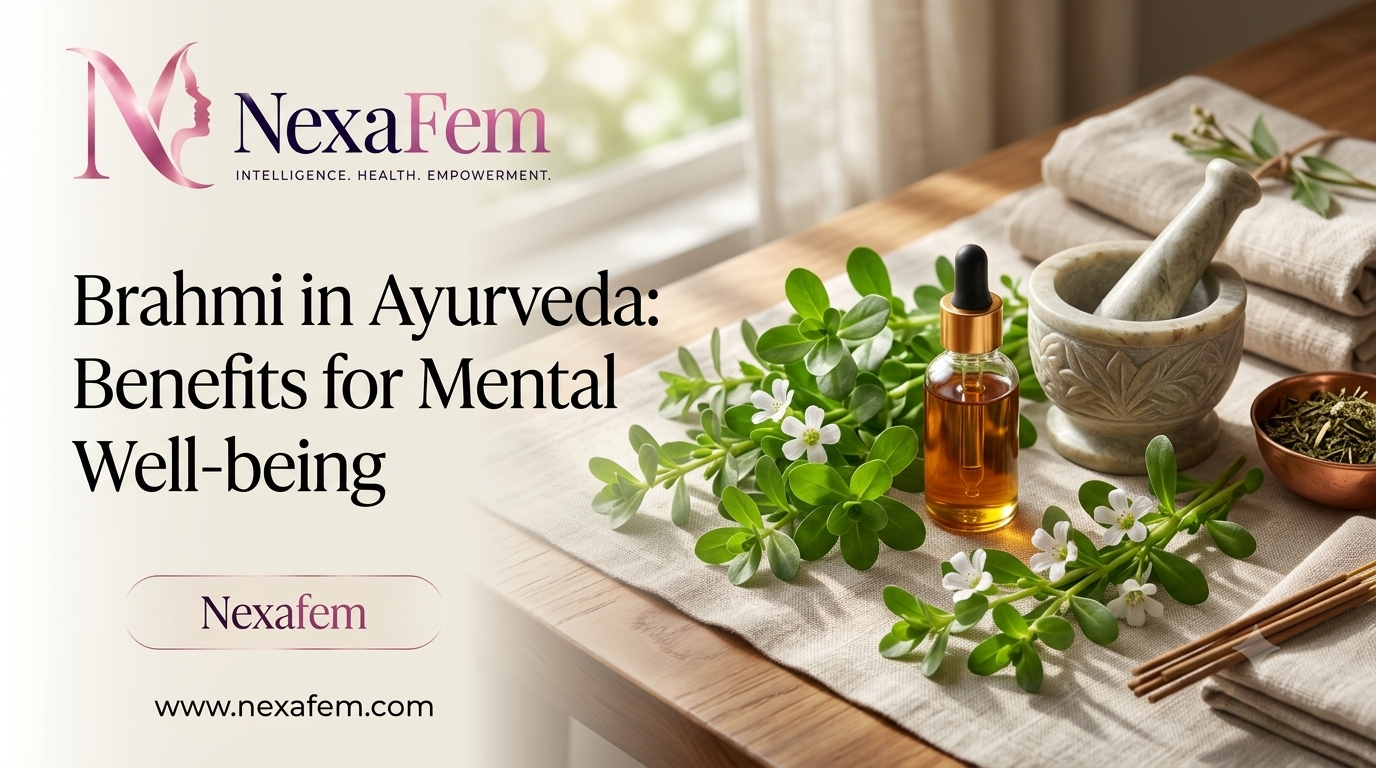
Brahmi in Ayurveda: Benefits for Mental Well-being
Learn how Brahmi may support memory, stress management and mental well-being, what research says, and important safety considerations.
Brahmi in Ayurveda: Supporting Mental Well-being Naturally
Feeling mentally tired can look different from one woman to another.
You may find yourself struggling to concentrate at work, forgetting small things, feeling mentally overloaded after a busy day, or finding it difficult to switch off at night. During periods of hormonal transition, including the menstrual cycle, postpartum period, perimenopause or menopause, changes in sleep, stress and mood can add another layer to that experience.
This is one reason Ayurvedic herbs such as Brahmi continue to attract interest.
Brahmi has a long history in Ayurveda and is traditionally associated with memory, learning and mental functioning. Modern research has also investigated Bacopa monnieri, commonly called Brahmi, particularly for cognitive performance and, to a lesser extent, stress and mood.
But there is an important distinction between traditional use and modern evidence.
Brahmi should not be viewed as a guaranteed treatment for anxiety, depression, insomnia or any other mental health condition. Current research is promising in some areas, particularly cognition, but results are not uniform and research on mental well-being remains limited.
So, what does Brahmi actually do? And how can women think about it safely?
Let's look at the traditional Ayurvedic perspective alongside what modern research currently tells us.
Quick Summary
Brahmi commonly refers to Bacopa monnieri, an Ayurvedic herb traditionally associated with memory, learning and mental functioning. The name can also refer to other plants in some traditional or commercial contexts, so botanical identification matters.
Human research suggests Bacopa may have potential cognitive benefits, particularly for aspects of memory, although studies have used different preparations and outcomes.
Evidence for stress, anxiety and broader mental well-being is less established than the evidence for cognition.
Brahmi is not a replacement for professional treatment for depression, anxiety or other mental health conditions.
Because herbal supplements can have side effects and potential medicine interactions, women who are pregnant, breastfeeding, taking medication or managing a chronic condition should seek professional advice before using concentrated Brahmi products.
What Is Brahmi?
Brahmi is an Ayurvedic medicinal herb traditionally associated with mental and cognitive health.
In modern scientific literature, the name Brahmi is most commonly used for Bacopa monnieri, a small creeping herb also known as water hyssop. India's Ministry of AYUSH's e-Charak knowledge resource lists Bacopa monnieri under the name Brahmi. (E Charak)
However, there is an important naming issue.
The word "Brahmi" has also historically been used for Centella asiatica in some Ayurvedic and commercial contexts. These are different plants with different chemical compositions. Therefore, if you are purchasing a supplement, checking the botanical name on the label is more reliable than relying only on the common name "Brahmi."
For this article, Brahmi refers primarily to Bacopa monnieri.
Bacopa contains several bioactive compounds, including a group of saponins commonly referred to as bacosides. These compounds are among the constituents researchers have investigated when studying Bacopa's biological effects. (CCRH India)
Brahmi in Ayurveda: The Traditional Perspective
Ayurveda has traditionally viewed mental well-being as part of overall health rather than something completely separate from the body.
Brahmi has traditionally been associated with functions involving memory, learning, concentration and mental clarity. Ayurvedic literature and modern reviews of Ayurvedic use describe Bacopa as a traditional brain or cognitive-supportive herb. (PubMed)
From an Ayurvedic perspective, the approach is also more individualised than simply asking whether a herb is "good" or "bad."
Factors such as constitution, digestion, lifestyle, sleep, stress and the individual's overall health may influence how an Ayurvedic practitioner approaches herbal use.
This is one reason self-prescribing an Ayurvedic herb based solely on an online article may not reflect traditional Ayurvedic practice.
Traditional knowledge vs modern evidence
It helps to keep these two ideas separate:
Traditional Ayurvedic perspective: Brahmi has historically been valued for supporting mental and cognitive functions.
Modern scientific perspective: Human clinical research has investigated Bacopa, with the strongest body of evidence focusing on aspects of cognition and memory. Evidence for anxiety, stress and broader mental well-being is more limited and inconsistent. (PubMed)
Practical takeaway: Brahmi can reasonably be discussed as an Ayurvedic herb of interest for cognitive and mental wellness, but it should not be presented as a proven treatment for a mental health disorder.
How Might Brahmi Support Mental Well-being?
The phrase "mental well-being" is broader than simply having a good memory.
It can include the ability to manage everyday stress, concentrate, sleep adequately, maintain emotional balance and function effectively in daily life.
WHO describes mental health as a state of mental well-being that supports coping with everyday stresses, learning, working and participating in life. (World Health Organization)
Research into Bacopa has explored several areas.
1. Memory and learning
This is currently one of the better-researched areas.
A systematic review of randomized controlled trials found some evidence that Bacopa could improve aspects of memory, particularly free recall. However, the researchers also noted that evidence for other cognitive abilities was limited. (PubMed)
A later meta-analysis involving nine studies and 518 participants also found potential cognitive benefits, including improvements in certain measures of attention and processing. The authors nevertheless emphasized the need for larger, well-designed studies. (PubMed)
More recently, a 2026 network meta-analysis of randomized trials reported promising effects of Bacopa on certain memory outcomes in healthy adults. However, the authors also noted limitations related to the available comparisons and study evidence. (PubMed)
So the fairest conclusion is:
Bacopa shows potential for supporting some aspects of cognition and memory, but it is not established as a universal memory-enhancing treatment.
2. Concentration and attention
Mental fatigue can make concentration difficult.
Some clinical studies have explored Bacopa's effects on attention and cognitive processing. Results have been mixed, but certain studies suggest possible improvements in specific cognitive tasks. (PubMed)
Importantly, an individual's ability to concentrate is also strongly influenced by sleep, stress, nutrition, physical activity and underlying health conditions.
A supplement cannot compensate for persistent sleep deprivation or untreated mental health problems.
3. Stress and emotional well-being
This is where the evidence requires more caution.
A small randomized crossover study found that a specific Bacopa extract was associated with some positive mood effects and reduced cortisol during a stressful multitasking situation. However, the researchers emphasized that the findings needed replication in larger studies. (PubMed)
A more recent 12-week randomized controlled trial in adults with self-reported memory and attention problems found potential stress-reduction and anti-fatigue effects, but did not find greater improvements in cognitive performance compared with placebo. Digestive complaints and headaches were reported more frequently in the Bacopa group. (PubMed)
This illustrates why responsible health communication matters: individual studies can produce encouraging findings without proving that an herb will work for everyone.
4. Anxiety
Bacopa has also been investigated for anxiety-related outcomes.
Some earlier trials reported potential improvements, but results have not been consistent. One controlled trial specifically investigating healthy Indian adults found results that challenged previously reported cognitive and anti-anxiety effects. (PubMed)
Therefore, there is currently not enough evidence to recommend Brahmi as a treatment for an anxiety disorder.
If anxiety is persistent, worsening or interfering with daily life, professional assessment is more appropriate than relying on an herbal supplement.
What Does Modern Research Actually Tell Us?
The scientific evidence around Brahmi is interesting but not definitive.
The strongest evidence is currently around cognitive outcomes, especially certain aspects of memory.
A systematic review found six randomized controlled trials lasting 12 weeks and reported improvements in some memory measures, while noting that evidence for other cognitive domains was sparse. (PubMed)
A separate meta-analysis of nine trials found potential cognitive improvements but called for better-designed studies before firm conclusions could be made. (PubMed)
The picture becomes less certain when moving from cognition to broader mental health.
A 2026 systematic review of Ayurvedic herbal products found that Bacopa research was particularly concentrated around cognition, while evidence across stress, sleep and psychiatric symptoms remained heterogeneous. The authors concluded that confidence in the size of benefits was limited by factors including study heterogeneity and reporting quality. (PubMed)
What this means for women
It would be reasonable to say:
Brahmi may have potential as part of a broader approach to cognitive and mental wellness, but current evidence does not establish it as a treatment for depression, anxiety or other mental health disorders.
That distinction protects readers from unrealistic expectations while still respecting the herb's traditional use and scientific potential.
Brahmi and Women's Mental Wellness
Women can experience changes in mood, concentration, sleep and perceived stress at different stages of life.
For example, mental fatigue may occur alongside:
demanding work or study schedules
inadequate sleep
prolonged stress
menstrual-cycle-related symptoms
pregnancy or postpartum changes
perimenopause
menopause
nutritional deficiencies
thyroid or other medical conditions
This does not mean Brahmi specifically treats these conditions.
Instead, it highlights why mental well-being should be approached holistically.
During perimenopause, for example, sleep disruption and hormonal changes can contribute to difficulties with concentration or mood. In such situations, an appropriate health assessment is more useful than assuming that an herbal supplement is the answer.
Similarly, persistent anxiety, low mood or significant cognitive changes deserve professional attention.
Lifestyle Habits Matter More Than Any Single Herb
If your goal is better mental well-being, Brahmi should never be considered in isolation.
WHO recommends healthy self-care practices such as adequate sleep, physical activity, nutritious food and maintaining social connections as important components of health and well-being. (World Health Organization)
Prioritise sleep
Poor sleep can affect concentration, memory, mood and stress tolerance.
Try to maintain a reasonably consistent sleep and wake schedule, create a relaxing bedtime routine and reduce stimulating screen use close to bedtime.
If sleep problems persist despite healthy habits, speak with a healthcare professional.
Stay physically active
Walking, cycling, strength training, yoga or another activity you enjoy can support both physical and mental health.
WHO notes that regular physical activity can improve well-being, sleep and symptoms associated with anxiety and depression. (World Health Organization)
The goal does not have to be intense exercise.
Consistency matters more than perfection.
Eat a balanced diet
There is no special "Brahmi diet" required to support mental wellness.
Instead, focus on an overall balanced eating pattern that includes vegetables, fruits, whole grains or other high-fibre carbohydrates, adequate protein, healthy fats and sufficient fluids.
If fatigue or concentration problems are persistent, deficiencies such as iron or vitamin B12 may sometimes need to be considered depending on the individual.
Make space for relaxation
Meditation, breathing exercises, journaling, prayer or quiet time can become part of a personal stress-management routine.
These practices do not need to be complicated.
Even a few minutes of intentional slowing down can provide a useful pause during a demanding day.
Consider yoga mindfully
Yoga may be a useful mind-body practice for women who enjoy it.
It can combine movement, breathing and attention, making it suitable as one component of a broader wellness routine.
However, yoga should complement—not replace—professional care when someone has significant anxiety, depression or another mental health condition.
Can Brahmi Be Part of a Daily Ayurvedic Wellness Routine?
Potentially, but the answer depends on what product is being used and who is using it.
Traditional Ayurvedic preparations and modern standardized extracts are not necessarily equivalent.
Research studies have often used standardized Bacopa extracts rather than the exact forms sold as household herbal products. Dosages, concentrations, extraction methods and bacoside content can differ considerably between products. (PubMed)
This means that a study using a particular standardized extract should not automatically be interpreted as evidence that every Brahmi powder, capsule or formulation will have the same effect.
For women considering supplementation, product quality and professional guidance matter.
Is Brahmi Safe?
Brahmi is generally described as reasonably well tolerated in human studies, but "natural" does not mean risk-free.
Gastrointestinal effects are among the more commonly reported concerns, including nausea, abdominal discomfort and increased stool frequency. (PubMed)
A recent randomized trial also reported digestive complaints and headaches more frequently among participants receiving Bacopa than placebo. (PubMed)
Possible medication interactions
Herbal products can affect how medicines are absorbed or metabolized.
Laboratory research has found that Bacopa extracts can affect several cytochrome P450 enzymes, although laboratory findings do not automatically mean a clinically significant interaction will occur in every person. (PubMed)
This is why women taking prescription medicines should discuss Brahmi with a doctor or pharmacist before using a concentrated supplement.
Pregnancy and breastfeeding
There is not enough reliable evidence to establish the safety of concentrated Bacopa supplementation during pregnancy and breastfeeding.
Women who are pregnant, planning pregnancy or breastfeeding should not self-start Brahmi supplements without discussing them with an appropriate healthcare professional. Available reviews also identify the need for further research on safety in pregnancy and breastfeeding. (PubMed)
Existing medical conditions
Extra caution is appropriate if you have a chronic condition, take several medicines, have a history of significant digestive problems or are considering Brahmi for a specific medical symptom.
An Ayurvedic practitioner can help assess the traditional context, while a doctor or pharmacist can assess medical safety and potential interactions.
Common Misconceptions About Brahmi
Myth 1: Brahmi cures anxiety
Fact: Some research has explored stress and anxiety-related outcomes, but evidence remains limited and inconsistent. Brahmi should not be promoted as a cure for anxiety disorders.
Myth 2: More Brahmi means better results
Fact: Higher doses are not automatically safer or more effective. Clinical studies use specific extracts and doses, and these findings cannot simply be applied to every commercial product.
Myth 3: Brahmi can replace antidepressants or anxiety medication
Fact: There is no basis for stopping prescribed treatment and substituting Brahmi. Anyone considering an herbal supplement alongside medication should discuss it with their healthcare professional.
Myth 4: All Brahmi products are the same
Fact: Products can differ in plant identity, extraction method, concentration and active constituents. Confirming the botanical name is particularly important because "Brahmi" can refer to different plants.
Myth 5: Mental health problems should be managed naturally first
Fact: Lifestyle and complementary approaches can be valuable, but mental health conditions may require evidence-based psychological or medical treatment. WHO notes that mental health conditions can be effectively treated and that people experiencing persistent distress should have access to appropriate care. (World Health Organization)
When Should You Speak to a Healthcare Professional?
Consider seeking professional help if you experience:
persistent anxiety or low mood
panic attacks
significant sleep problems
difficulty functioning at work, college or home
persistent memory or concentration changes
unexplained or severe fatigue
major changes in appetite or weight
symptoms that interfere with relationships or daily life
thoughts of self-harm or suicide
Mental health concerns deserve the same seriousness and compassion as physical health concerns.
If you have thoughts of harming yourself or feel unable to stay safe, seek urgent local emergency or crisis support and involve someone you trust immediately.
A Practical, Evidence-Informed Approach to Brahmi
If you're interested in Brahmi because you want to support your mental well-being, consider this order of priorities:
First: Understand what you are trying to address. Is it everyday stress, poor sleep, concentration difficulties or persistent anxiety?
Second: Look at the foundations—sleep, nutrition, physical activity, stress management and social connection.
Third: If symptoms persist, investigate possible underlying causes with a healthcare professional.
Fourth: If you still want to explore Brahmi, choose a clearly identified product and discuss it with a qualified healthcare professional or Ayurveda practitioner, particularly if you take medication or have a medical condition.
This approach respects both traditional wellness practices and modern healthcare.
Health Disclaimer: This article is intended for informational and educational purposes only and is not a substitute for professional medical advice, diagnosis or treatment. The information about Brahmi and Ayurveda describes traditional uses and available research; it should not be interpreted as a guaranteed treatment or cure for any medical or mental health condition. Do not stop or change prescribed medication based on this information. If you are pregnant, breastfeeding, taking medication, managing a chronic condition or experiencing persistent mental health symptoms, consult a qualified healthcare professional before using Brahmi or any herbal supplement. For individualized Ayurvedic guidance, consult a qualified Ayurveda practitioner.
Sources & References
PubMed — The cognitive-enhancing effects of Bacopa monnieri: systematic review of randomized controlled trials (PubMed)
PubMed — Meta-analysis of randomized controlled trials on cognitive effects of Bacopa monnieri (PubMed)
PubMed — 2026 network meta-analysis comparing Bacopa and Ginkgo (PubMed)
PubMed — 2025 randomized trial of Bacopa, cognition, stress and fatigue (PubMed)
PubMed — Bacopa and stress reactivity/mood randomized crossover study (PubMed)
PubMed — Bacopa monnieri clinical overview and safety information (PubMed)
WHO — Stress: Questions and Answers (World Health Organization)
WHO — Self-care for health and well-being (World Health Organization)
Frequently Asked Questions
Share this post
Comments (0)
No comments yet. Be the first to comment!