
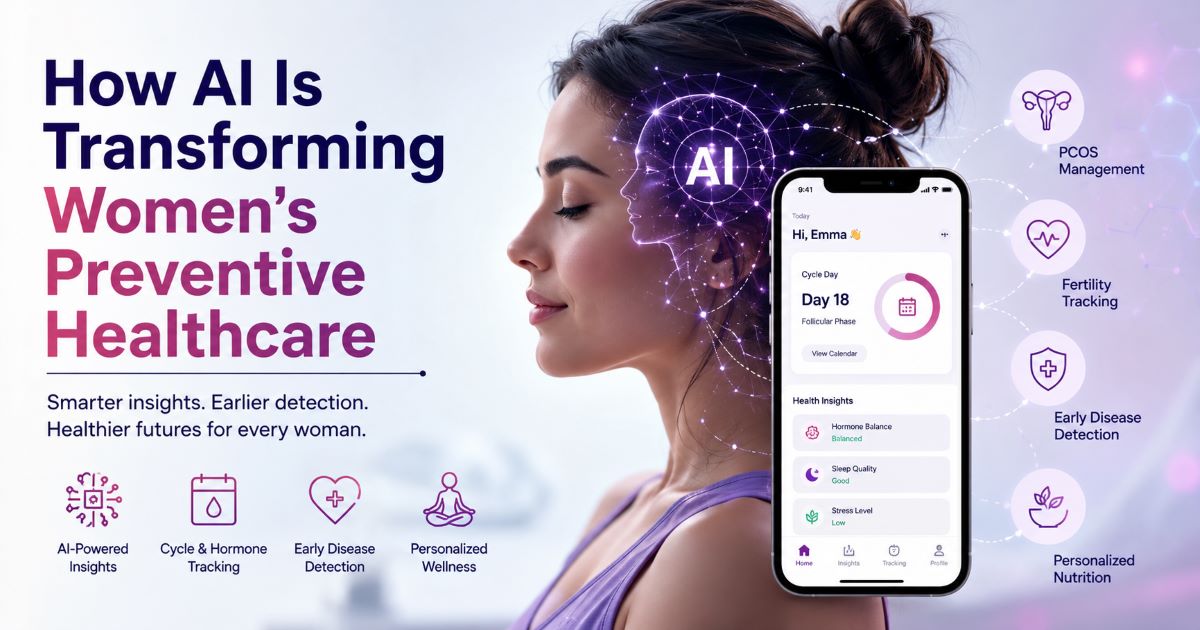
How AI Is Transforming Women's Preventive Healthcare
Artificial Intelligence is revolutionizing women's healthcare by improving PCOS diagnosis, hormonal health tracking, fertility planning, and early disease detection. Discover how AI-powered tools, wearables, and personalized health insights are helping women take control of their preventive healthcare like never before.
Introduction: A System That Was Not Built for Women
For most of modern medical history, women's health has been an afterthought.
Clinical trials excluded women for decades. Medical textbooks described female anatomy as a variation of male anatomy. Conditions like endometriosis took an average of seven to ten years to diagnose. PCOS — affecting one in ten women of reproductive age — was, and in many places still is, dismissed, misdiagnosed, or managed with a prescription for the birth control pill and very little else.
The result is a generation of women who learned to normalize pain, to second-guess their own symptoms, to fight for answers in a system that was not designed to listen to them. Many women with PCOS know this experience intimately: the years of irregular cycles explained away as stress, the weight gain attributed to lifestyle choices rather than insulin resistance, the acne treated as a cosmetic issue rather than a hormonal signal.
Something is changing. Artificial intelligence — AI — is beginning to do something that the conventional medical system has struggled to do for women: pay close attention to patterns, listen to the full picture, and catch problems before they become crises.
This article is not about technology for its own sake. It is about what AI-powered tools are beginning to make possible for women managing PCOS, hormonal imbalances, and the broader landscape of preventive health — and why this shift matters enormously for the quality of care women receive and the degree of understanding they have of their own bodies.
SEO Keywords to note throughout this article: AI women's healthcare, artificial intelligence PCOS management, AI hormonal health tools, women's preventive healthcare technology, AI period tracking PCOS, machine learning women's health, early disease detection women AI, AI fertility tracking, personalized women's healthcare AI, PCOS diagnosis artificial intelligence, digital health tools for women, AI and endometriosis detection, wearable health technology women, AI mental health support women, hormonal imbalance AI tools, preventive health AI women, PCOS lifestyle management technology, AI nutrition recommendations women, remote women's healthcare AI, future of women's health technology
Part One: What AI Actually Means in a Healthcare Context
Before exploring what AI is doing for women's health, it helps to understand what the term actually means in a medical context — because it is used loosely and often in ways that obscure more than they clarify.
Artificial intelligence in healthcare refers to the use of computer systems that can learn from large amounts of data, identify patterns within that data, and use those patterns to make predictions, flag anomalies, or generate personalized recommendations. The most relevant forms for women's health include machine learning, which identifies patterns across thousands or millions of data points that no human analyst could detect manually, and natural language processing, which allows AI systems to understand and respond to human language — the technology behind health chatbots and symptom-checking tools.
What makes AI particularly powerful in a medical context is scale. A human doctor, no matter how skilled, has limited time and limited exposure to patient data. An AI system trained on the health data of millions of women can recognize patterns — in cycle data, in symptom combinations, in metabolic markers — that would be entirely invisible to any individual clinician.
For women with PCOS, whose condition is characterized by a highly variable constellation of symptoms that can look completely different from one woman to the next, this pattern-recognition capacity has profound implications.
Part Two: AI and the PCOS Diagnosis Problem
One of the most persistent failures of conventional healthcare for women with PCOS is the diagnosis gap.
The average time from symptom onset to PCOS diagnosis is currently between two and three years, though many women report waiting far longer. During that time, women are often told their irregular cycles are stress, their acne is normal teenage skin, their weight gain is a lifestyle problem, and their mood changes are anxiety or personality. The hormonal picture that connects these symptoms goes unrecognized.
AI is beginning to address this directly.
Pattern Recognition Across Symptom Combinations
Machine learning systems trained on large datasets of women with confirmed PCOS diagnoses are demonstrating an impressive ability to identify the condition from symptom combinations — including atypical presentations — earlier and more reliably than standard diagnostic pathways.
Researchers have developed AI models that can predict PCOS with significant accuracy using combinations of menstrual cycle data, hormonal blood markers, metabolic indicators, and self-reported symptoms. These systems do not rely on any single diagnostic marker — they recognize the pattern of the condition across multiple data streams simultaneously, much as an experienced specialist would, but faster and at far greater scale.
Several digital health platforms are now incorporating these models into symptom-tracking tools that prompt women to seek evaluation when their logged data suggests a pattern consistent with hormonal dysfunction. For women in areas with limited access to specialist gynaecological care, this kind of early flagging can make a meaningful difference in how quickly they receive appropriate diagnosis and support.
Ultrasound Analysis and Image Recognition
Transvaginal ultrasound, used to assess the ovaries for the characteristic appearance of PCOS, is a skill-dependent procedure. The accuracy of interpretation varies significantly based on the experience of the person performing and reading the scan.
AI-powered image recognition tools are being developed and tested that can analyze ultrasound images with a consistency and accuracy that does not vary with operator experience or fatigue. These tools can identify the small follicular cysts characteristic of PCOS, assess follicle count and distribution, and flag images that deviate from normal with a reliability that is comparable to expert human analysis.
As these tools become integrated into standard imaging workflows, they have the potential to significantly reduce the misinterpretation of ultrasound findings that has historically contributed to PCOS misdiagnosis — both over-diagnosis in women who have follicular cysts without hormonal PCOS, and under-diagnosis in women whose ovarian appearance is atypical.
Part Three: Cycle Tracking Evolved — AI-Powered Period and Fertility Apps
Period tracking is not new. Women have been recording their cycles on calendars for as long as there have been calendars. But the generation of AI-powered cycle tracking tools now available represents a genuine qualitative shift in what that data can tell you.
From Calendar to Pattern Intelligence
Traditional period tracking apps recorded when your period started and ended, calculated an average, and predicted the next cycle based on that average. For women with PCOS — whose cycles are often irregular, unpredictable, and highly variable — these apps were frustratingly useless, because an average of wildly varying cycle lengths produces predictions that are reliably wrong.
AI-powered cycle apps approach the data differently. Rather than calculating a simple average, they use machine learning algorithms that recognize the underlying patterns and contributors to cycle variability. They can learn, over time, how your specific cycle responds to changes in sleep, stress, activity level, and nutrition, and adjust predictions accordingly. They can flag when a cycle deviation is within your normal range of variability versus when it represents a meaningful departure that might warrant investigation.
For women with PCOS, this kind of individualized pattern recognition is far more clinically useful than generic average-based predictions. It treats your cycle as what it actually is: a dynamic, responsive biological system rather than a fixed clockwork mechanism.
Symptom Correlation and Hormonal Insights
The most sophisticated AI cycle tools go beyond tracking dates to correlating symptoms across the cycle. Women can log mood, energy, sleep quality, skin changes, bloating, pain levels, food cravings, and dozens of other variables, and the AI identifies relationships between these logged symptoms and cycle phase, hormonal patterns, and external factors.
For a woman with PCOS trying to understand her body, this kind of symptom correlation can be revelatory. The insight that skin flares consistently precede a long luteal phase, or that energy levels are reliably lower in the days following poor sleep, or that mood dips correlate with cycle phases that suggest low progesterone — this is information that helps women understand their bodies with a precision that was not previously available outside of expensive and time-consuming medical testing.
Some platforms are now integrating wearable device data — temperature, heart rate variability, sleep stages — with cycle and symptom logs to build an even richer picture of the hormonal patterns underlying a woman's experience. Continuous body temperature tracking, in particular, is becoming increasingly useful for identifying ovulation and characterizing the luteal phase in women with PCOS who are trying to understand whether and when they ovulate.
Part Four: AI in Fertility and Reproductive Medicine
Fertility challenges are among the most distressing consequences of PCOS, and the application of AI to reproductive medicine is one of the most active and rapidly advancing areas of healthcare technology.
Ovulation Prediction for Irregular Cycles
Standard ovulation prediction kits, which detect the LH surge that precedes ovulation, are useful for women with regular cycles. For women with PCOS, who may have multiple partial LH surges without ovulation, or who may ovulate very irregularly across a long and variable cycle, standard OPKs are far less reliable.
AI-powered fertility platforms are developing more sophisticated approaches to ovulation detection that integrate multiple physiological signals — basal body temperature, cycle history, hormone testing results, and symptom patterns — to predict ovulation windows with higher accuracy for women with irregular cycles. These platforms learn from each cycle, becoming more accurate over time as they accumulate individual data.
IVF Outcome Prediction and Embryo Selection
In clinical fertility settings, AI is being used to improve the outcomes of in vitro fertilization — a procedure that is both emotionally and financially demanding, and that is used by many women with PCOS who have difficulty conceiving naturally.
Machine learning models trained on large datasets of IVF cycles can predict the likelihood of success based on a combination of patient characteristics, hormonal profiles, and stimulation response data. They are also being used to assess embryo quality through image analysis — identifying the embryos most likely to result in successful implantation based on subtle visual characteristics that are difficult for human embryologists to assess consistently.
These tools do not replace the clinical judgment of fertility specialists. They augment it, providing an additional layer of analysis that can improve the probability of a successful outcome and reduce the number of cycles — and the associated emotional and physical cost — that women must undergo.
Part Five: Early Detection of Conditions That Disproportionately Affect Women
Preventive healthcare is fundamentally about detecting problems before they become crises. For women, several serious health conditions are chronically underdetected or detected late — not because the signals are not present, but because they are not being looked for systematically. AI is beginning to change this.
Cardiovascular Disease in Women
Heart disease is the leading cause of death in women globally, yet it remains dramatically underrecognized as a women's health issue. Women with PCOS have a significantly elevated risk of cardiovascular disease due to the metabolic effects of insulin resistance, chronic inflammation, and androgen excess — yet cardiovascular risk assessment in women with PCOS is frequently omitted from routine care.
Women's cardiovascular disease also presents differently from men's. The chest-clutching heart attack of popular imagination is less common in women, who are more likely to experience atypical symptoms: fatigue, shortness of breath, nausea, back pain, jaw pain. These atypical presentations have historically led to delayed diagnosis and worse outcomes.
AI models trained specifically on women's cardiovascular data are demonstrating the ability to identify cardiovascular risk earlier and more accurately than traditional risk calculators, which were developed predominantly from male patient data. These models can recognize the subtler risk patterns that characterize women's cardiovascular disease — including the metabolic risk profile common in PCOS — and flag women for preventive intervention before a clinical event occurs.
Thyroid Disease
Thyroid disorders affect women at five to eight times the rate of men, and they are frequently co-occurring with PCOS. Hypothyroidism in particular — where the thyroid produces insufficient hormone — causes symptoms including fatigue, weight gain, mood changes, hair thinning, and menstrual irregularity that overlap substantially with PCOS symptoms, complicating diagnosis and management.
AI-powered diagnostic tools are being developed that can identify thyroid dysfunction from combinations of symptoms, lab values, and clinical data with greater consistency than symptom-based assessment alone. Some researchers are also developing AI models that can analyze the ultrasound appearance of the thyroid to detect nodules and early structural changes that may warrant further investigation.
Endometriosis
Endometriosis affects approximately one in ten women of reproductive age and is notoriously difficult to diagnose — currently requiring surgical confirmation, which contributes to the average diagnostic delay of seven to ten years. During that time, many women are told their pain is normal, psychosomatic, or exaggerated.
AI researchers are actively working on non-invasive diagnostic models for endometriosis that analyze combinations of symptom patterns, menstrual cycle characteristics, pain profiles, and potentially imaging data to identify women likely to have the condition and prioritize them for specialist evaluation. While these models are not yet at clinical deployment at scale, the research is promising and represents one of the most meaningful potential applications of AI for women's health.
Cervical and Ovarian Cancer Screening
AI image analysis tools are already being deployed in cervical screening programs, where they assist in the analysis of cervical cell images to identify abnormal cells that may indicate precancerous changes. These tools increase the consistency of screening interpretation and can help address the bottleneck of limited pathologist capacity in healthcare systems.
For ovarian cancer — one of the deadliest cancers in women precisely because it is most often detected at a late stage — AI researchers are working on models that can identify early risk patterns from combinations of blood markers, imaging data, and clinical history. Early-stage ovarian cancer detection remains one of the most significant unsolved problems in women's oncology, and AI-assisted pattern recognition offers a genuinely promising avenue.
Part Six: AI-Powered Personalized Nutrition and Lifestyle Support for PCOS
Managing PCOS through lifestyle — nutrition, movement, stress management, sleep — is well-established in the medical literature as one of the most effective interventions available. But the generic advice that most women receive — "eat less sugar," "exercise more," "reduce stress" — is insufficiently specific to produce meaningful results, and it places the entire burden of implementation on the individual without meaningful support.
AI is beginning to change what personalized lifestyle support for PCOS actually looks like.
Personalized Nutrition Guidance
Nutrition for PCOS is not one-size-fits-all. Women with PCOS vary significantly in their degree of insulin resistance, their inflammatory load, their androgen levels, their weight, their food preferences, and their lifestyle constraints. What works well for one woman — a lower-carbohydrate approach, for example — may be unsuitable or unsustainable for another.
AI-powered nutrition platforms can integrate personal health data — cycle tracking, food logs, blood sugar patterns, energy levels, sleep quality — and generate genuinely individualized nutrition recommendations that adapt over time based on the woman's responses. Some platforms are integrating continuous glucose monitoring data with AI analysis to show women in real time how specific foods affect their blood sugar and, by extension, their insulin and hormonal environment.
This level of personalization was previously available only to women who could afford extensive private nutritional testing and ongoing dietitian support. AI-powered tools are democratizing access to individualized guidance in ways that have the potential to meaningfully improve PCOS management across a far wider population.
Movement and Recovery Optimization
Exercise is a powerful tool for PCOS management — it improves insulin sensitivity, reduces cortisol, supports mood, and helps manage weight. But as discussed in the context of female athlete health, exercise can also be a stressor that worsens hormonal balance when it is excessive or poorly calibrated to the body's current state.
AI-powered fitness platforms that integrate cycle tracking with exercise planning are now available, allowing women to adapt their training intensity and type to their cycle phase — scheduling more demanding workouts in the follicular phase when energy and resilience are typically higher, and prioritizing lower-intensity movement in the luteal phase and during menstruation when the body's recovery needs are greater.
For women with PCOS who are navigating the balance between enough exercise to improve insulin sensitivity and too much exercise to worsen cortisol load, this kind of cycle-synced, AI-guided approach offers practical support grounded in their actual hormonal patterns.
Mental Health Support
The psychological burden of PCOS is significant and frequently underaddressed. Women with PCOS experience depression at approximately three times the rate of women without the condition, and anxiety at approximately six times the rate. The combination of chronic symptoms, diagnostic delays, body image challenges, and fertility concerns creates a mental health load that conventional healthcare rarely addresses systematically.
AI-powered mental health support tools — including therapy chatbots, mood-tracking applications, and CBT-based digital programs — are not a replacement for professional mental health care. But for women who are on waiting lists for therapy, who cannot afford regular sessions, or who simply want additional support between appointments, these tools offer meaningful supplementary resources.
The most effective of these tools are beginning to integrate with cycle-tracking data so that mood support prompts and interventions can be timed to the phases of the cycle when emotional vulnerability is highest — the late luteal phase particularly — rather than being delivered uniformly regardless of hormonal context.
Part Seven: Wearable Technology and Continuous Health Monitoring
Wearable health technology — smartwatches, fitness trackers, temperature rings, continuous glucose monitors — is generating a continuous stream of physiological data that AI systems can analyze for patterns relevant to women's health.
Heart Rate Variability as a Stress and Recovery Marker
Heart rate variability (HRV) — the variation in time between heartbeats — is one of the most sensitive physiological markers of autonomic nervous system health and recovery status. High HRV generally indicates good cardiovascular health and nervous system resilience; low HRV indicates stress, poor recovery, or physiological strain.
For women with PCOS, who are already operating with a more reactive stress response and a higher baseline cortisol load, HRV monitoring can provide an early warning that the body is approaching depletion before more obvious symptoms emerge. AI analysis of continuous HRV data can distinguish normal day-to-day variability from patterns that suggest the need for rest, reduced training load, or stress intervention.
Continuous Glucose Monitoring
Continuous glucose monitors (CGMs), originally developed for diabetes management, are increasingly being used by women without diabetes to understand their blood sugar responses to food, exercise, stress, and sleep. For women with PCOS and insulin resistance, this data is particularly valuable — it makes visible the blood sugar fluctuations that drive cravings, energy crashes, mood instability, and hormonal disruption.
AI analysis of CGM data can identify patterns — the foods that spike blood sugar most significantly for a specific individual, the timing of meals relative to exercise that produces the most stable glucose response, the relationship between sleep quality and next-day glucose regulation — that are highly specific to the individual and impossible to derive from generic dietary guidelines.
Sleep Stage Tracking
The relationship between sleep and hormonal health has been established clearly in research. AI analysis of wearable sleep data — sleep stages, sleep duration, sleep consistency, and overnight heart rate patterns — can identify sleep disruption patterns associated with hormonal dysregulation and provide specific, actionable guidance for improvement.
For women with PCOS who frequently experience the 2 to 4 AM waking associated with blood sugar dysregulation, or the difficulty falling asleep associated with elevated cortisol, or the non-restorative sleep associated with underlying sleep apnea (which is significantly more common in PCOS than in the general female population), AI-analyzed sleep data can help connect the physiological dots.
Part Eight: The Important Limitations to Acknowledge
A balanced view of AI in women's healthcare requires honest acknowledgment of the limitations and risks that currently exist alongside the genuine promise.
Data Bias
AI systems are only as good as the data they are trained on. Historically, medical data has underrepresented women — particularly women of color, women in lower-income populations, and women with conditions that have been systematically understudied. AI models trained on biased or non-representative datasets will reproduce and potentially amplify existing healthcare inequities.
This is a real and significant concern. As AI tools move toward clinical deployment, rigorous evaluation of how they perform across diverse populations — not just the populations most represented in training data — is essential. Women who are already most underserved by the healthcare system must not be further disadvantaged by AI tools that were not built with their data in mind.
Privacy and Data Security
The kind of detailed, continuous personal health data that AI tools require — cycle data, symptom logs, glucose levels, sleep patterns, location data — is deeply intimate. Women using AI health tools are sharing information about their bodies, their fertility, their mental health, and their daily lives with technology platforms that have commercial interests.
Data privacy policies in the digital health space are variable and not always transparent. Women using AI health tools have a right to understand how their data is being stored, used, and potentially shared. Advocating for strong data privacy regulations in digital health — and choosing platforms with clear, protective data policies — is an important dimension of using these tools safely.
AI Is Not a Doctor
The most capable AI diagnostic tool currently available is not a substitute for a clinical relationship with a knowledgeable, attentive healthcare provider. AI tools can flag patterns, suggest considerations, personalize recommendations, and augment clinical decision-making. They cannot examine you, understand the full context of your life and health history, provide the relational support of a therapeutic clinical relationship, or take clinical responsibility for your care.
The ideal use of AI in women's healthcare is as a powerful addition to — not a replacement for — good medical care. For women with PCOS especially, the goal is to use AI tools to arrive at clinical appointments better informed, with richer data, and better equipped to advocate for the care you need.
Part Nine: How to Start Using AI Health Tools Wisely
If you have PCOS or hormonal health concerns and want to begin using AI-powered tools to support your health, here is practical guidance on where to start.
Begin with a high-quality cycle tracking app that uses AI-driven analysis rather than simple average calculation. Look for platforms that allow detailed symptom logging across multiple domains — mood, energy, skin, sleep, digestion, pain — and that provide pattern analysis rather than just cycle date predictions.
If you have confirmed or suspected insulin resistance, consider discussing continuous glucose monitoring with your healthcare provider. Even two to four weeks of CGM data can provide insights about your blood sugar patterns that significantly inform nutrition and lifestyle decisions.
Use wearable health data — if you already wear a smartwatch or fitness tracker — as a source of objective information about your sleep quality, recovery status, and activity patterns, rather than simply as a step counter. The HRV and sleep data available from most modern wearables, analyzed over time, provides meaningful insights.
Bring your AI-generated data to your medical appointments. The pattern insights from cycle tracking apps, glucose monitoring, and symptom correlation tools are genuinely useful clinical data. A doctor who is dismissive of patient-generated data is one worth replacing.
Finally, approach these tools with critical awareness. No app knows your body better than you do. AI tools provide data and pattern analysis; they do not provide wisdom about what that data means for your specific life and health. Use them as a source of information and hypotheses to explore — not as a source of diagnoses or definitive answers.
Closing Thoughts: Technology in Service of Women Who Were Not Listened To
The promise of AI in women's preventive healthcare is not simply technological efficiency. It is something more meaningful than that.
For generations, women's health symptoms were minimized, dismissed, and inadequately studied. The average woman with PCOS spent years being told that nothing was wrong with her before receiving a diagnosis. The average woman with endometriosis spent a decade in pain before being believed. The average woman with cardiovascular disease received less aggressive treatment than her male counterpart because the research that shaped clinical guidelines was not conducted on people like her.
AI will not solve these problems on its own. The biases embedded in medical culture, clinical training, and healthcare systems are human problems that require human solutions — advocacy, research investment, policy change, and a fundamental shift in how women's experience is received by the medical establishment.
But AI tools that listen carefully, recognize patterns that individual clinicians might miss, personalize guidance in ways that generic protocols cannot, and give women richer data about their own bodies — these tools are contributing to something important. They are giving women information, language, and evidence to advocate for themselves more effectively. And for many women, that changes everything.
You have always known something was happening in your body. Now the technology is finally starting to catch up.
Frequently Asked Questions
Share this post
Comments (0)
No comments yet. Be the first to comment!