
What Every Teenage Girl Should Know About Hormonal Health
Hormones influence everything from mood, energy, sleep, and skin health to menstrual cycles and emotional wellbeing. This comprehensive guide explains what every teenage girl should know about hormonal health, including puberty, PMS, acne, PCOS, stress, nutrition, and the lifestyle habits that support healthy hormone balance during adolescence and beyond.
Introduction: Nobody Told You Any of This, Did They?
You were handed a pamphlet in health class. Maybe someone explained the basics of a menstrual cycle with a diagram. And then you were largely left to figure out the rest on your own — why your skin erupts before your period, why your emotions can swing so dramatically in a single day, why you feel exhausted some weeks and energized in others, why your weight changes even when nothing else does.
Hormones govern nearly every aspect of your physical and emotional experience during the teenage years, yet most girls receive shockingly little education about how this system actually works. The result is years of confusion, self-blame, and unnecessary suffering — feeling like something is wrong with you when your body is simply doing exactly what it is designed to do.
This article exists to fill that gap. It is written for teenage girls who want real answers, not vague reassurances. It is also written for mothers, older sisters, aunts, and anyone who supports a young woman trying to make sense of her body. The more you understand your hormonal health now, the better equipped you will be to protect it for decades to come.
SEO Keywords to note throughout this article: hormonal health for teenage girls, teen girl hormones explained, puberty hormones girls, what causes PMS in teenagers, teenage girl hormonal imbalance signs, hormones and mood in teenagers, period health for teen girls, estrogen and progesterone in puberty, teenage acne and hormones, PCOS signs in teenage girls, hormonal health education girls, teen mental health and hormones, how to balance hormones as a teenager, teenage girl health guide, puberty and the menstrual cycle, cortisol and teen girls stress, insulin and teenage hormonal health, sleep and hormones in teenagers, nutrition for teenage hormonal health, signs of hormonal imbalance teenage girl
Part One: Understanding What Hormones Actually Are
Before anything else makes sense, you need to understand what hormones are and why they matter so much.
Hormones are chemical messengers produced by glands in your body — the thyroid, adrenal glands, ovaries, pancreas, and others — and released into your bloodstream. They travel to target cells and tissues throughout your body and instruct them to do specific things: grow, change, produce energy, regulate mood, trigger menstruation, store fat, repair tissue, and much more.
Think of your body as a vast network of communication. Hormones are the signals moving through that network constantly, coordinating everything from your sleep cycle to your hunger levels to whether you ovulate this month. When the signals are clear and balanced, you feel well. When they are disrupted — by stress, poor nutrition, inadequate sleep, environmental exposures, or underlying health conditions — the effects ripple through your body in ways that feel deeply personal, because they are.
During the teenage years, your body is producing hormones in patterns and quantities it has never produced before. The system is being built in real time. Some turbulence is entirely normal. But understanding the difference between normal hormonal fluctuation and signs that something needs attention is one of the most valuable things a young woman can know.
Part Two: The Key Hormones Every Teenage Girl Should Know
You do not need a medical degree to understand your hormones. Here are the most important ones and what they actually do in your body.
Estrogen
Estrogen is the primary female sex hormone, though it does much more than define reproductive function. It is produced mainly in the ovaries and plays a central role in the development of breasts and curves during puberty, the regulation of the menstrual cycle, the health of your bones and cardiovascular system, and the regulation of mood through its influence on serotonin — your brain's primary feel-good neurotransmitter.
Estrogen rises in the first half of your menstrual cycle, peaking just before ovulation. During this phase, many girls feel more energetic, sociable, and mentally sharp. When estrogen is in healthy balance, it supports clear skin, emotional stability, and physical vitality.
When estrogen is too high relative to progesterone — a condition called estrogen dominance — you may experience heavy or painful periods, breast tenderness, bloating, mood swings, and acne. When estrogen is too low — which can happen with extreme stress, undereating, or overexercising — periods may become irregular or stop altogether.
Progesterone
Progesterone is produced in the second half of the menstrual cycle, after ovulation. It is often called the calming hormone because of its influence on GABA receptors in the brain — the same receptors that anti-anxiety medications target. When progesterone is adequate, it supports restful sleep, emotional steadiness, and a sense of calm.
In teenagers, progesterone levels are often still establishing themselves. It can take several years after the first period for ovulation to become consistent, and without ovulation, the body does not produce meaningful progesterone. This is one reason why many teenage girls experience significant PMS, mood swings, and sleep disruption — their cycles may not yet be fully ovulatory.
This is not a permanent problem, but it is worth understanding. Cycles that are irregular, very long, or accompanied by minimal physical signs of ovulation may indicate that the body is not yet ovulating consistently.
Testosterone
Testosterone is often thought of as exclusively a male hormone, but girls produce it too — in smaller amounts, primarily in the adrenal glands and ovaries. In balanced quantities, testosterone supports energy, motivation, physical strength, and healthy libido.
During puberty, testosterone rises in both boys and girls. In girls, this rise contributes to the development of pubic and underarm hair, and is one of the hormones responsible for acne — it stimulates the sebaceous glands in the skin to produce more oil.
When testosterone is elevated in girls — which can occur in conditions like polycystic ovary syndrome (PCOS) — it can cause more severe acne, excess facial or body hair, and irregular or absent periods.
Insulin
Insulin is produced by the pancreas and is responsible for regulating blood sugar. When you eat — especially carbohydrates — your blood sugar rises, insulin is released, and it helps your cells absorb glucose for energy.
Insulin is critically important to hormonal health, particularly for teenage girls, because it directly interacts with the reproductive hormones. When insulin is frequently elevated — due to a diet high in refined sugar and processed carbohydrates, or due to a condition called insulin resistance — it stimulates the ovaries to produce more testosterone. This is the hormonal chain that links high-sugar diets to acne, irregular periods, and in more significant cases, PCOS.
Understanding insulin is not about avoiding carbohydrates entirely — it is about understanding that the quality and balance of what you eat directly influences your hormonal environment.
Cortisol
Cortisol is your primary stress hormone, produced by the adrenal glands. It exists for very good reasons: in a genuine emergency, cortisol mobilizes energy, sharpens focus, and prepares the body for physical action.
The problem is that the teenage years — with academic pressure, social stress, family dynamics, comparison on social media, and the underlying biological upheaval of puberty — generate a great deal of cortisol, far more than the body was designed to handle on a sustained basis.
Chronically elevated cortisol disrupts nearly everything: it impairs sleep, worsens acne, raises blood sugar, suppresses progesterone production, interferes with thyroid function, and contributes to anxiety and low mood. Understanding cortisol is essential for any teenage girl, because managing stress is not just good advice — it is hormonal medicine.
Melatonin and the Sleep Hormones
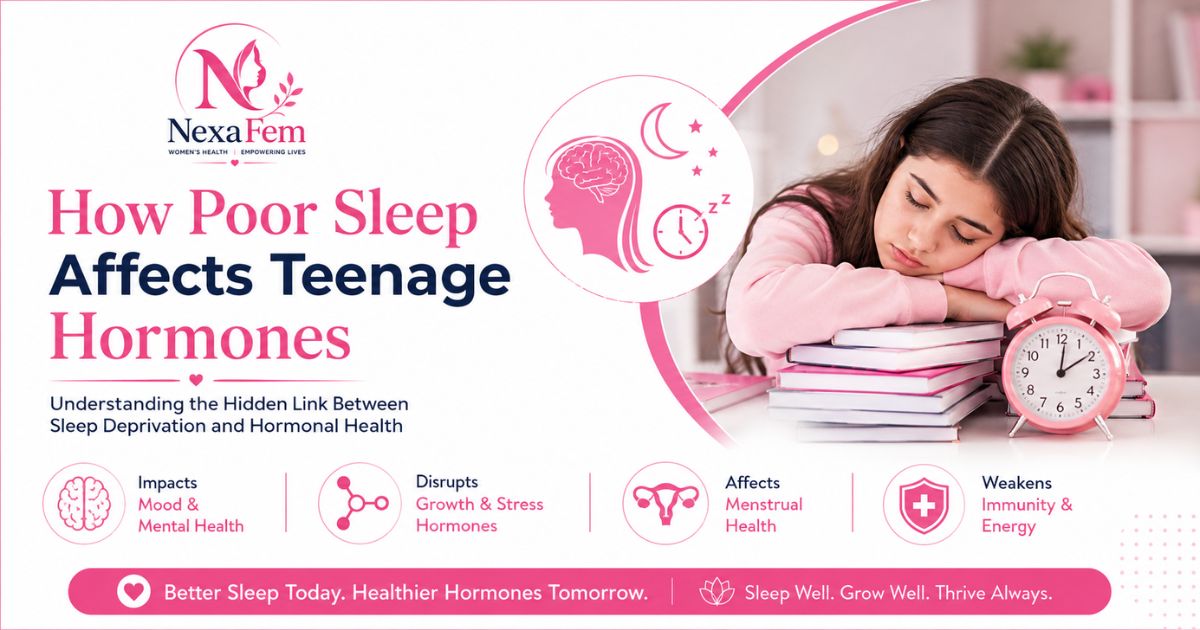
Melatonin is produced by the pineal gland in response to darkness and signals to the body that it is time to sleep. During puberty, the natural melatonin release is biologically delayed — meaning teenagers genuinely feel alert later at night and struggle to feel awake in the early morning. This is not laziness. It is a documented shift in circadian biology.
The consequence is that most teenage girls are chronically sleep-deprived in a way that is partly social (early school start times, screens, social pressures) and partly biological. And since sleep is when the majority of hormonal regulation, repair, and balance occurs, this chronic sleep deficit has real consequences for every other hormone in the system.
Part Three: Your Menstrual Cycle Is a Vital Sign
One of the most important shifts in how you can think about your period is this: your menstrual cycle is not an inconvenience. It is a monthly report card on your hormonal health.
The American College of Obstetricians and Gynecologists has formally recognized the menstrual cycle as a vital sign — in the same category as heart rate, blood pressure, and temperature — because it provides reliable information about the overall state of a girl's health.
What a Healthy Cycle Looks Like
A healthy menstrual cycle typically occurs every 21 to 35 days and is counted from the first day of one period to the first day of the next. The period itself generally lasts between three and seven days. Flow is moderate — not so light that you barely need protection and not so heavy that you are soaking through products every hour or passing large clots.
Some cramping is normal, particularly in the first day or two. Mild premenstrual symptoms — breast tenderness, mild bloating, emotional sensitivity — are also within the range of normal. What is not normal, even though it is extremely common, is pain so severe it prevents you from going to school or normal activities, periods so heavy they cause dizziness or fatigue, or premenstrual symptoms so intense they significantly impair your quality of life.
What Irregular Cycles Mean
In the first one to two years after your first period, irregular cycles are expected. Your hypothalamic-pituitary-ovarian axis — the hormonal feedback loop that governs the menstrual cycle — is still maturing. Give it time.
However, if cycles remain very irregular, very long (longer than 35 days consistently), absent for months at a time, or are accompanied by significant symptoms, it is worth speaking with a doctor. Irregular cycles in teenagers can reflect a number of things: the body still maturing, high stress levels, undereating or overexercising, thyroid disorders, or conditions like PCOS that are worth identifying early.
Tracking your cycle — even simply noting the first day of each period in a calendar or an app — is one of the most useful health habits you can start now. It gives you data about your own body that no one else can provide.
Part Four: Acne, Hair Changes, and Skin — The Hormonal Connection
If there is one topic that connects almost every teenage girl's experience of hormones, it is skin. Hormonal acne is one of the most emotionally charged aspects of puberty, and it deserves a thoughtful explanation — not dismissal.
Why Hormonal Acne Happens
Acne during the teenage years is primarily driven by androgens — testosterone and its derivatives — which rise during puberty in both boys and girls. Androgens stimulate the sebaceous glands to produce more sebum (skin oil). Excess sebum, combined with dead skin cells and bacteria, clogs pores and creates the inflammatory response we see as acne.
In girls, this process is also influenced by the menstrual cycle. Many girls notice that their acne worsens in the week or two before their period — the luteal phase — when estrogen drops and relative androgen influence increases. This is called cyclical acne and is directly tied to hormonal fluctuation.
Insulin also plays a role. High-glycemic foods — refined sugar, white bread, sugary drinks — spike blood sugar and insulin, which in turn elevates androgens and worsens acne. This is why some girls find that adjusting their diet has a meaningful impact on their skin, even without changing their skincare routine.
What Hormonal Acne Looks Like
Hormonal acne in girls tends to appear around the jaw, chin, and lower cheeks — the lower third of the face. It is often deeper, more inflamed, and more painful than non-hormonal acne. It may appear as cysts or nodules rather than surface blackheads.
If acne is severe, persistent, or accompanied by other signs like excess facial or body hair, irregular periods, or significant weight gain around the abdomen, it is worth discussing PCOS or other hormonal conditions with a doctor.
Other Skin and Hair Changes
Oily skin and hair are normal during puberty and result from the same androgen-driven sebaceous gland activity that causes acne. Some girls also experience increased body hair and a change in hair texture on the scalp.
Hair loss or significant thinning — particularly around the temples or the top of the scalp — in a teenage girl can indicate elevated androgens, iron deficiency (very common in girls who have started their periods), thyroid dysfunction, or nutritional deficiency. If you are noticing significant hair shedding, this is worth investigating rather than accepting as normal.
Part Five: Mood, Mental Health, and Hormones
The emotional turbulence of the teenage years is real, it is biological, and it is not a sign that you are dramatic, oversensitive, or difficult. Understanding the hormonal basis of mood changes does not excuse harmful behavior or mean feelings are not valid — it means you deserve an explanation, not just an eye roll.
Estrogen and Serotonin
Estrogen has a direct influence on serotonin, the neurotransmitter most associated with mood stability, feelings of wellbeing, and emotional resilience. As estrogen fluctuates across the menstrual cycle, so does serotonin activity. This is why many girls feel more emotionally stable and optimistic in the first half of their cycle (when estrogen is rising) and more emotionally vulnerable in the second half and premenstrually (when estrogen drops).
This hormonal influence on serotonin is also why conditions like depression and anxiety are significantly more common in girls than boys after puberty begins. Before puberty, the rates are roughly equal. After puberty, girls are diagnosed with depression and anxiety at approximately twice the rate of boys. Hormones are a significant contributing factor to this disparity.
PMDD — When PMS Goes Further
Premenstrual dysphoric disorder (PMDD) is a severe form of PMS that is not simply "bad moods" before a period. It involves significant depression, anxiety, irritability, or emotional dysregulation in the luteal phase — the two weeks before menstruation — that resolves within a few days of the period starting.
PMDD affects approximately 3 to 8 percent of women of reproductive age, and it can begin in adolescence. It is often dismissed as teenage moodiness, which means many girls suffer for years without diagnosis or support. If your emotional symptoms before your period are severely affecting your relationships, school performance, or sense of self, please speak with a doctor. PMDD is a recognized medical condition with effective treatments.
Anxiety and the Teenage Hormonal Environment
The teenage years are already a period of heightened social awareness, identity formation, and environmental uncertainty — all of which generate cortisol. Layer on top of this the progesterone fluctuations of an immature menstrual cycle, the sleep deprivation endemic to adolescence, and the relentless social comparison that social media creates, and it is not surprising that anxiety is at epidemic levels among teenage girls.
Understanding that anxiety has real physiological roots — that it is not weakness or a personality flaw — is important. So is understanding that managing the hormonal foundations of anxiety (sleep, blood sugar stability, cortisol management, adequate nutrition) can meaningfully reduce its severity.
Part Six: What PCOS Is and Why Teenage Girls Should Know About It
Polycystic ovary syndrome (PCOS) is the most common hormonal condition in women of reproductive age, affecting approximately 1 in 10 women. It frequently begins in adolescence, and yet many girls are not diagnosed until years — sometimes decades — after symptoms first appear.
What PCOS Actually Is
PCOS is a condition characterized by elevated androgens (male hormones), irregular or absent ovulation, and often the presence of small follicles on the ovaries visible on ultrasound. It is strongly associated with insulin resistance — meaning the body's cells do not respond normally to insulin, leading to higher circulating insulin levels which then further elevate androgens.
Importantly, you do not have to be overweight to have PCOS. Many girls with PCOS are a completely typical weight. Lean PCOS is common and is often diagnosed later because it does not fit the stereotypical image.
Signs of PCOS in Teenage Girls
Because irregular cycles are normal in the first couple of years after puberty begins, PCOS can be difficult to diagnose in teenagers. However, certain patterns are worth discussing with a doctor:
Cycles that remain irregular or absent two or more years after the first period begins. Significant acne that is persistent and does not respond well to typical treatments. Excess hair growth on the face, chest, abdomen, or inner thighs — a condition called hirsutism. Hair thinning or loss on the scalp in a male-pattern distribution. Significant difficulty losing weight despite consistent effort, or rapid unexplained weight gain. Skin darkening in the creases of the neck, armpits, or groin — a sign called acanthosis nigricans, which indicates insulin resistance.
Why Early Identification Matters
PCOS that is identified and managed early leads to significantly better long-term outcomes. Unmanaged PCOS in adolescence is associated with higher risks of developing type 2 diabetes, cardiovascular disease, and significant mental health challenges including depression and anxiety in adulthood.
Early lifestyle interventions — particularly those that reduce insulin resistance through nutrition, movement, and stress management — are highly effective in adolescents and can meaningfully alter the trajectory of the condition. This is not about being afraid of a diagnosis. It is about having information that allows you to make choices that support your health from a foundation of understanding rather than ignorance.
Part Seven: The Foundations of Hormonal Health for Teenage Girls
Understanding your hormones is one thing. Supporting them is another. Here are the most important foundations, explained honestly and without pressure.
Food as Hormonal Information
Every meal you eat sends information to your hormonal system. This does not mean food needs to be a source of anxiety — it means that what you eat genuinely matters to how you feel, and that knowledge is empowering rather than restrictive.
The most important nutritional principles for teenage hormonal health are:
Keeping blood sugar stable. This means building meals around protein, healthy fats, and fiber, with carbohydrates as a supporting element rather than the entire foundation. It means reducing the frequency of high-sugar, high-refined-carbohydrate eating — not eliminating these foods, but not building every meal and snack around them.
Eating enough. This is perhaps the most important point for teenage girls. Undereating — whether through intentional dieting, disordered restriction, or simply not prioritizing food — is one of the fastest ways to disrupt hormonal health. Your ovaries need adequate energy and nutrients to function. Your brain needs adequate nutrition to produce the neurotransmitters that regulate mood. When the body perceives energy scarcity, it suppresses reproductive function as a matter of biological priority. Irregular or absent periods in a teenage girl who is restricting food are a medical signal, not a health achievement.
Getting enough iron. Once menstruation begins, girls lose iron monthly. Iron deficiency is extremely common in teenage girls and causes fatigue, brain fog, poor concentration, and reduced athletic performance — all of which are frequently attributed to other causes. Eating iron-rich foods (red meat, legumes, leafy greens) or having iron levels checked regularly is important.
Supporting gut health. The gut microbiome plays a significant role in estrogen metabolism. A healthy, diverse microbiome — supported by adequate fiber, fermented foods, and reduced ultra-processed food intake — helps the body process and clear hormones efficiently.
Sleep as Hormonal Medicine
It bears repeating: sleep is not passive. It is one of the most active and productive things your body does, and the majority of hormonal regulation, including growth hormone release, cortisol reset, and reproductive hormone calibration, happens during sleep.
Teenage girls need between eight and ten hours of sleep per night. This is not an exaggeration. Given the biological delay in melatonin release during adolescence, this means most teenage girls would ideally be asleep between 10 or 11 PM and waking between 7 and 9 AM — a schedule that is at odds with most school systems but represents genuine biological need.
If full sleep optimization is not possible, protecting the hours you do have matters. Keeping screens out of the bedroom, lowering light levels in the evening, and establishing a consistent sleep and wake time even on weekends all support the hormonal benefits of sleep.
Movement That Supports, Not Stresses
Regular physical movement is one of the most powerful tools for hormonal health. It improves insulin sensitivity, reduces cortisol, supports sleep, boosts mood through endorphins, and maintains healthy bone density during the critical bone-building years of adolescence.
The important caveat for teenage girls is that more is not always better. High-intensity exercise performed daily, combined with inadequate food intake, can suppress ovarian function and lead to what is called relative energy deficiency in sport (RED-S) — a condition previously known as the female athlete triad. Signs of RED-S include irregular or absent periods, stress fractures, fatigue, and declining athletic performance. If you are very active and your period has become irregular or stopped, please speak with a doctor or sports medicine professional.
The ideal movement for hormonal health is varied — some strength training, some cardiovascular exercise, some lower-intensity movement like walking or yoga — and always paired with sufficient food intake to support the energy demands.
Managing Stress — Not Eliminating It
Stress is a permanent feature of human life, including teenage life. The goal is not to eliminate it but to build a nervous system that can move through stress without staying stuck in the cortisol response.
For teenage girls, this is particularly relevant because the social environment of adolescence — with its shifting friendships, academic pressures, performance expectations, and social media comparison — generates a sustained low-level cortisol output that is genuinely harmful over time.
Practices that support nervous system recovery include: time in nature without a device, regular movement, creative activities that absorb your attention, genuine rest and unstructured time, conversations with people you trust, and setting boundaries around social media use. These are not soft suggestions. They are direct interventions in your cortisol and hormonal environment.
Part Eight: When to Ask for Help
There is a difference between normal hormonal fluctuation and symptoms that deserve medical attention. Here is a clear guide to when to speak with a doctor.
Periods that are still irregular more than two years after your first period. Periods that are absent for three months or more without pregnancy. Bleeding so heavy that you are soaking through a pad or tampon every hour for several hours, or passing clots larger than a quarter. Period pain so severe it prevents normal activities and does not respond to typical pain relief. Significant premenstrual mood changes that substantially impair your quality of life. Signs of excess androgens: persistent severe acne, significant facial or body hair growth, or scalp hair thinning. Fatigue that is persistent and severe even with adequate sleep. Significant unexplained weight changes. Signs of insulin resistance such as dark patches on the skin.
If any of these apply to you, please advocate for yourself. You deserve to be taken seriously, and you deserve answers. If one doctor dismisses your concerns, finding another who will listen is completely appropriate and often necessary.
A Note to the Women Who Love Teenage Girls
If you are a mother, older sister, aunt, mentor, or any woman in a teenage girl's life: the information in this article is also for you to share, discuss, and normalize.
Many of the women who struggle most with hormonal health in adulthood — with PCOS, endometriosis, thyroid disorders, anxiety, burnout, and fertility challenges — first experienced symptoms as teenagers that were dismissed, minimized, or attributed to normal adolescence. Earlier conversations could have meant earlier support, earlier diagnosis, and a very different experience of the years that followed.
Talking openly about periods, mood, food, sleep, and hormonal health with the young women in your life is one of the most meaningful gifts you can give them. Not to create anxiety about their bodies, but to give them language, context, and confidence in their own experience.
Closing Thoughts: Your Body Is Not the Problem
If there is one thing to carry from this article, it is this: your body is not the problem. Your hormones are not out to make your life difficult. They are a complex, responsive system that is working hard during these years, and they are sending you real information about what they need.
The confusion, the symptoms, the questions you have been carrying — they are valid. You deserve clear answers, not dismissal. You deserve a relationship with your body that is based on understanding rather than frustration.
The teenage years are not just something to survive hormonally. They are the foundation of your lifelong health. What you learn, how you eat, how you sleep, how you manage stress, and how you pay attention to your body right now all shape the hormonal landscape of your adult life.
You have more influence over that landscape than anyone has probably told you. And now, at least in part, you know why.
This article is for educational purposes and is not a substitute for personalized medical advice. If you have concerns about your hormonal health, please speak with a qualified healthcare provider.
References
American College of Obstetricians and Gynecologists (ACOG) – Menstrual cycle as a vital sign and adolescent gynecologic health.
Office on Women's Health – Puberty, menstrual health, and hormonal health resources.
Mayo Clinic – Information on puberty, PCOS, menstrual cycles, and adolescent health.
National Institute of Child Health and Human Development (NICHD) – Research on puberty and adolescent development.
American Academy of Pediatrics (AAP) – Adolescent health and wellness guidance.
Medical DisclaimerDisclaimer: This article is intended for educational and informational purposes only and should not be considered medical advice. Hormonal changes during adolescence are normal, but symptoms such as severe menstrual irregularities, excessive pain, persistent fatigue, significant mood changes, or signs of hormonal imbalance should be evaluated by a qualified healthcare professional. Always consult a healthcare provider for personalized medical guidance.
Frequently Asked Questions
Share this post
Comments (0)
No comments yet. Be the first to comment!