
Ashoka in Ayurveda: Benefits for Women's Wellness
Explore Ashoka in Ayurveda, its traditional uses for women's wellness, menstrual health, emerging research and important safety considerations.
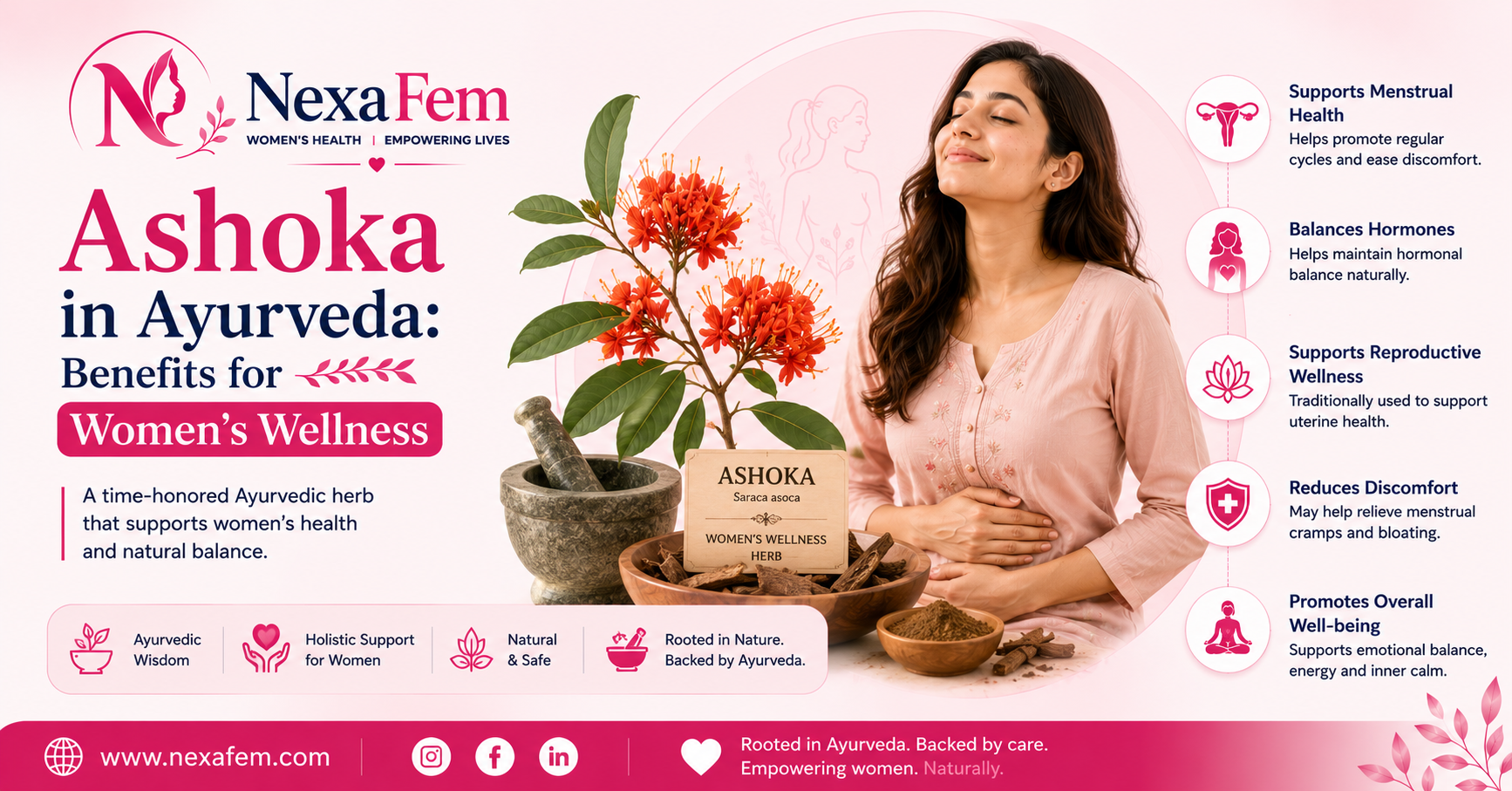
Ashoka in Ayurveda: Traditional Benefits for Women's Wellness
Women's health has always been an important part of Ayurveda, and several traditional herbs have been associated with reproductive and menstrual wellbeing. Ashoka, botanically known as Saraca asoca, is one of the best-known plants in this tradition.
The Ashoka tree also has deep cultural significance in India. Beyond its cultural importance, its bark has historically been used in Ayurvedic preparations associated with women's reproductive health.
Today, Ashoka is often promoted online for menstrual problems, heavy periods, hormonal balance, PCOS and menopause. But traditional use and modern scientific evidence are not the same thing.
So, what does Ashoka in Ayurveda actually mean for women's wellness?
The most balanced answer is that Ashoka has a long history of traditional use for gynecological concerns, while modern research is still developing. Laboratory and animal studies suggest potentially relevant biological activity, but high-quality human evidence for Ashoka as a standalone treatment remains limited. A comprehensive 2023 review specifically concluded that more systematic research, including safety and toxicology studies, is needed. (PubMed)
That distinction matters. Traditional knowledge can be respected without turning it into a promise of medical treatment.
Quick Summary
Ashoka (Saraca asoca) is a traditional Ayurvedic medicinal plant, with its bark being an important medicinal part. The Ministry of Ayush's E-Charak database lists Saraca asoca and identifies bark as the relevant plant part. (E Charak)
Ayurveda has traditionally associated Ashoka with women's reproductive and menstrual health, including menstrual disorders.
Modern research has identified biological activities of Ashoka extracts, including estrogen-related activity in laboratory and animal research, but this does not establish that Ashoka “balances hormones” in women. (PubMed)
Evidence for specific conditions such as PCOS, heavy menstrual bleeding or menopause is not strong enough to treat Ashoka as a proven standalone therapy.
Herbal products can vary in identity and quality, so natural does not automatically mean safe.
What Is Ashoka?
Ashoka is the common name for Saraca asoca (Roxb.) Willd., a tree native to the Indian subcontinent and valued in traditional Indian medicine.
It is sometimes confused with other plants because the name “Ashoka” may be used loosely in herbal markets. Correct botanical identification is therefore important.
The bark is particularly important in Ayurvedic preparations. The Ministry of Ayush's E-Charak medicinal-plant database lists Saraca asoca with bark as the medicinal plant part. (E Charak)
Ashoka also has cultural significance in India and has been regarded as a sacred or culturally important tree. A 2023 scientific review describes its long history in Indian tradition and medicine while also highlighting concerns around conservation and the need for better pharmacological and safety research. (PubMed)
Why Is Ashoka Important in Ayurveda?
Traditional Ayurvedic Perspective
Ashoka has traditionally been associated with women's reproductive health and is used in Ayurvedic formulations for gynecological concerns.
Traditional applications have included menstrual and uterine-related complaints. Historical literature and traditional medical use have particularly linked Ashoka bark preparations with menstrual disorders.
One example is Ashokarishta, a fermented Ayurvedic formulation in which Ashoka bark is a major ingredient. Historical clinical and pharmacological literature has examined its use for gynecological complaints. (PubMed)
It is important, however, not to assume that every traditional indication has been validated through modern clinical trials.
What Modern Evidence Says
Scientific research has identified several phytochemicals in Saraca asoca and has investigated possible pharmacological activities.
A comprehensive review published in the Journal of Ethnopharmacology summarized traditional uses, phytochemistry and biological research but emphasized that more research is needed to systematically establish clinical properties, safety and toxicology. (PubMed)
Practical Takeaway
Ashoka has a substantial traditional history in women's health, but traditional use should not be presented as proof that Ashoka treats a specific gynecological disease.
Traditional Uses of Ashoka for Women's Wellness
Ashoka has historically been used in Ayurveda and other traditional medical systems in the context of women's reproductive health.
Traditional applications have included concerns such as:
Menstrual disorders
Excessive menstrual bleeding
Menstrual discomfort
Uterine-related complaints
Certain vaginal or reproductive complaints
Older literature also documents the use of Ashoka-based preparations for menstrual and gynecological conditions. However, these historical descriptions are not equivalent to evidence from modern randomized controlled trials. (PubMed)
A responsible article therefore needs to use wording such as “traditionally used for” rather than “proven to treat.”
Ashoka and Menstrual Health
Menstrual health is one of the areas most closely associated with Ashoka in Ayurveda.
A healthy menstrual cycle involves coordinated communication between the brain, ovaries and uterus. Changes in bleeding, cycle length or pain can have many causes.
For example, menstrual changes can be associated with:
PCOS
Fibroids
Endometriosis
Adenomyosis
Thyroid disorders
Pregnancy
Perimenopause
Certain medications
Bleeding disorders
Changes in weight or physical activity
This is why an irregular or unusually heavy period should not automatically be interpreted as a simple “hormonal imbalance.”
Traditional Ayurvedic Perspective
Ashoka has traditionally been used in formulations intended to support menstrual and uterine health.
What Modern Evidence Says
There is biological research suggesting that Ashoka extracts may influence pathways relevant to reproductive physiology, but much of the evidence is preclinical.
For example, researchers have investigated standardized Ashoka flower extract for estrogenic activity in an ovariectomized rat model. This type of study can help identify biological mechanisms worth investigating, but animal findings cannot be assumed to produce the same effects in women. (PubMed)
Practical Takeaway
Ashoka's traditional relationship with menstrual health is well established, but stronger human clinical research is needed before specific menstrual benefits can be stated with confidence.
Ashoka and Heavy Menstrual Bleeding
Heavy menstrual bleeding can be exhausting and can sometimes lead to iron-deficiency anemia.
Traditional Ayurvedic use of Ashoka has included preparations for excessive menstrual bleeding and other menstrual disorders. Historical literature describes Ashoka-based preparations in the context of menorrhagia and metrorrhagia. (PubMed)
However, heavy menstrual bleeding can also be a symptom of an underlying medical condition.
If your periods are unusually heavy, medical evaluation may be necessary to identify causes such as fibroids, adenomyosis, endometriosis, hormonal disorders or bleeding problems.
Ashoka should not be used to delay evaluation of persistent or severe bleeding.
When heavy bleeding deserves attention
Speak with a healthcare professional if:
You regularly need to change pads or tampons very frequently.
Your periods last unusually long.
You pass large clots repeatedly.
You feel unusually tired, weak or breathless.
Heavy bleeding interferes with normal daily activities.
Bleeding occurs between periods or after sex.
You develop sudden or severe bleeding.
Severe bleeding accompanied by dizziness, fainting, weakness or other concerning symptoms warrants prompt medical attention.
Ashoka and Menstrual Discomfort
Period pain is common, but severe menstrual pain is not something women should simply be expected to tolerate.
Pain may be related to ordinary menstrual cramping, but significant or worsening pain can also occur with conditions such as endometriosis, adenomyosis or fibroids.
Ashoka has traditionally been included in Ayurvedic approaches to gynecological health, but there is not enough robust evidence to recommend Ashoka as a standalone treatment for menstrual pain.
If pain is severe, new, progressively worsening or interfering with work, education, sleep or relationships, medical evaluation is appropriate.
Ashoka, PCOS and Hormonal Health
PCOS is a complex reproductive and metabolic condition. It can involve irregular ovulation, androgen excess and metabolic abnormalities.
Because Ashoka is traditionally associated with women's reproductive health, it is sometimes marketed online as a “hormone-balancing” herb for PCOS.
That claim needs caution.
Current research on Saraca asoca and PCOS includes preclinical work investigating possible mechanisms. One recent study explored compounds from Saraca asoca as potential aromatase inhibitors using computational and animal approaches. Such findings are useful for generating research hypotheses, but they do not establish clinical effectiveness in women with PCOS. (PubMed)
A broader review of Ayurvedic approaches to PCOS also found that the clinical literature includes many different herbs, formulations and complex interventions, while emphasizing the need for better safety reporting and stronger research. (PubMed)
Practical Takeaway
There is currently not enough high-quality evidence to recommend Ashoka as a treatment or cure for PCOS.
Women with PCOS should receive appropriate assessment and evidence-based care. Ashoka, if considered as complementary support, should be discussed with a qualified professional.
Ashoka and Menopause
Menopause is another area where women may encounter Ashoka in traditional wellness recommendations.
It is important to distinguish Ashoka itself from multi-herb formulations containing Ashoka.
A clinical study investigated a combination of Ashokarishta, Ashwagandha Churna and Praval Pishti in women with mild to moderate menopausal symptoms and reported improvements in symptom scores. However, because the intervention contained multiple products, the results cannot be used to conclude that Ashoka alone caused the observed effects. (PubMed)
This is a useful example of why herbal research needs careful interpretation.
If a study tests three ingredients together, we cannot confidently attribute the outcome to one herb.
For women experiencing significant hot flashes, sleep disturbance, vaginal symptoms, mood changes or abnormal bleeding during perimenopause or menopause, a healthcare professional can discuss evidence-based options alongside appropriate lifestyle measures.
What Does Modern Research Say About Ashoka?
The scientific evidence surrounding Ashoka can be broadly divided into three categories.
1. Traditional and historical evidence
Ashoka has a long history of use in Indian traditional medicine, especially for gynecological concerns. (PubMed)
2. Laboratory and animal research
Researchers have investigated extracts for antioxidant, anti-inflammatory, estrogen-related and other biological activities.
For example, an animal study examined estrogenic activity of a standardized Ashoka flower extract. (PubMed)
These findings can help researchers understand possible mechanisms but cannot establish human clinical benefits.
3. Human clinical evidence
Human evidence exists for some Ashoka-containing formulations, but it is much less extensive than online marketing may suggest.
A historical evaluation of Ashoka-based Ayurvedic medicine specifically called for clinical trials to establish therapeutic effects. (PubMed)
The 2023 comprehensive review likewise emphasized the need for more research into clinical properties, safety and toxicology. (PubMed)
The evidence in simple terms
Traditional use: Strong historical presence.
Laboratory research: Biologically interesting findings.
Animal research: Some potentially relevant effects.
Human clinical evidence: Limited and often formulation-specific.
Established medical treatment: Not established for broad claims such as “hormone balancing” or “curing menstrual disorders.”
Ashoka Bark and Ayurvedic Preparations
Ashoka bark is commonly discussed in relation to Ayurvedic formulations.
The Ministry of Ayush's E-Charak resource identifies Saraca asoca and bark as its medicinal plant part. (E Charak)
One of the best-known preparations is Ashokarishta, a fermented Ayurvedic formulation traditionally used in women's health.
However, Ashokarishta is not the same thing as taking Ashoka bark alone.
A formulation may contain multiple ingredients, and the method of preparation can change its chemical composition and biological effects.
This distinction matters when reading research.
If a study investigates Ashokarishta, its findings should not automatically be applied to an Ashoka powder or capsule.
Ashoka vs Ashokarishta: Are They the Same?
No. Ashoka generally refers to Saraca asoca, the medicinal plant.
Ashokarishta is a traditional fermented Ayurvedic formulation that contains Ashoka as a principal ingredient along with other ingredients.
They should not be treated as interchangeable products.
The dose, formulation, preparation method and additional ingredients can all influence safety and effects.
If you are considering an Ayurvedic formulation, it is better to discuss the specific product rather than simply asking whether “Ashoka” is safe.
Safety and Precautions
One of the most important principles of responsible herbal medicine communication is simple:
Natural does not automatically mean safe.
Safety can depend on:
Plant identification
Part of the plant used
Extraction method
Dose
Product quality
Other ingredients
Duration of use
Individual health conditions
Medicines being taken
Product identification matters
Ashoka is a highly traded medicinal plant, and research has documented concerns about adulteration and substitution in commercial raw herbal materials. DNA barcoding and phytochemical testing have been investigated as methods for authenticating Saraca asoca. (PubMed)
This means that choosing a reputable source is important.
Pregnancy and breastfeeding
Pregnancy requires particular caution with herbal medicines.
Do not assume that an herb traditionally used for menstrual or uterine health is appropriate during pregnancy.
If you are pregnant, trying to conceive or breastfeeding, speak with your obstetrician, physician or qualified Ayurveda practitioner before using Ashoka-containing products.
Medicines and chronic conditions
If you take prescription medication or manage a chronic condition, discuss herbal products with a healthcare professional or pharmacist.
This is especially important when using multi-ingredient Ayurvedic formulations.
Heavy metals and contamination
Quality control is another consideration.
A systematic review of heavy-metal toxicity associated with traditional Indian medicine documented cases involving lead, mercury and other metals and highlighted the importance of proper manufacturing, quality control and safety standards. (PubMed)
This does not mean every Ayurvedic product contains harmful metals. It means consumers should not assume that every traditional product is automatically well manufactured or contaminant-free.
WHO has also emphasized the importance of strengthened regulatory standards and quality assurance for herbal medicines internationally. (World Health Organization)
Common Myths About Ashoka
Myth 1: Ashoka balances all female hormones.
There is no single clinical definition of “female hormone balance.”
Laboratory or animal evidence of hormonal activity does not prove that Ashoka normalizes hormone levels in women.
Myth 2: Ashoka cures menstrual problems.
No.
Ashoka has traditional uses related to menstrual health, but menstrual problems have many different causes. Appropriate diagnosis matters.
Myth 3: Ashoka cures PCOS.
There is currently insufficient clinical evidence to make that claim.
PCOS requires individualized medical and lifestyle management.
Myth 4: Ashoka is always safe because it is natural.
No.
Herbal products can vary in quality and may have safety considerations or potential interactions.
Myth 5: Ashoka and Ashokarishta are identical.
They are not.
Ashokarishta is a multi-ingredient Ayurvedic formulation, while Ashoka refers to the plant Saraca asoca.
When Should You See a Doctor?
Ashoka should never be used as a reason to postpone medical assessment.
Consider speaking with a healthcare professional if you experience:
Very heavy menstrual bleeding
Persistent irregular periods
Bleeding between periods
Bleeding after sex
Severe or worsening period pain
New pelvic pain
Unexplained fatigue or weakness
Difficulty becoming pregnant
Unexpected bleeding after menopause
Rapidly changing menstrual patterns during midlife
Postmenopausal bleeding deserves medical evaluation. It should not be assumed to be a normal hormonal change or managed solely with herbal products.
Likewise, persistent menstrual problems in younger women deserve evaluation because symptoms can sometimes indicate PCOS, endometriosis, fibroids, thyroid disorders or other conditions.
Can Ashoka Be Part of a Women's Wellness Routine?
A responsible approach to Ayurveda does not have to revolve around taking an herb.
Women's health is influenced by many foundational factors:
Nutrition
A varied diet with sufficient protein, fibre, healthy fats, vitamins and minerals supports overall health.
Physical activity
Regular movement can benefit cardiovascular, metabolic, bone and mental health.
Sleep
Consistent, restorative sleep supports physical and emotional wellbeing.
Stress management
Meditation, yoga, breathing practices and other evidence-informed approaches may help women manage stress.
Menstrual awareness
Tracking cycle length, bleeding patterns, pain and other symptoms can help identify meaningful changes.
Preventive healthcare
Regular health assessments and appropriate screening remain important even when you use traditional wellness practices.
Ashoka may be considered within a broader, individualized approach to wellbeing, but it should not become a substitute for these fundamentals.
A Responsible Way to Think About Ashoka
If you are considering Ashoka, ask yourself three questions.
First: What am I trying to address?
“Women's hormonal health” is broad. A specific symptom such as heavy bleeding, pelvic pain or irregular periods may need medical evaluation.
Second: What does the evidence actually show?
Traditional use provides context, while clinical research tells us how confidently a treatment can be recommended.
Third: Is the specific product appropriate for me?
A standardized research extract, raw bark powder and a multi-herb formulation are not necessarily equivalent.
This approach allows women to appreciate Ayurveda without accepting exaggerated claims.
Key Takeaway
Ashoka (Saraca asoca) has a long and important history in Ayurveda, particularly in traditional approaches to women's reproductive and menstrual wellbeing. The bark is a recognized medicinal part of the plant in Indian traditional medicine. (E Charak)
Modern research has identified potentially interesting biological properties, including estrogen-related activity in preclinical studies. However, the evidence for Ashoka as a standalone treatment for menstrual disorders, PCOS, hormonal imbalance or menopause remains limited. (PubMed)
The most responsible way to use this information is to respect the traditional role of Ashoka while remaining honest about the limits of current evidence.
Ayurveda can be part of a broader conversation about women's wellness, but unexplained symptoms deserve proper medical evaluation.
Your health does not need an “either Ayurveda or modern medicine” approach. When appropriate, traditional practices and evidence-based healthcare can be considered together, with safety, quality and informed decision-making at the centre.
Sources & References
Urumarudappa S.K.J., et al. — Comprehensive review of Saraca asoca. Journal of Ethnopharmacology, 2023.
PubMed — A comprehensive review on Saraca asocaMinistry of Ayush — E-Charak medicinal plant database. The database identifies Saraca asoca (Ashoka) and lists bark as the medicinal plant part.
Ministry of Ayush — E-CharakEvaluation of Asoka Aristha — historical pharmacological evaluation.
PubMed — Evaluation of Asoka AristhaActivity-based evaluation of Saraca asoca flowers for estrogenic activity in an animal model.
PubMed — Saraca asoca estrogenic activity studyDNA barcoding and authentication research on Saraca asoca.
PubMed — Authentication and adulteration of Saraca asocaResearch on adulteration of Ayurvedic raw drugs using DNA barcoding and HPTLC.
PubMed — Authentication of Ayurvedic raw drugsHeavy metals in Indian traditional systems of medicine — systematic scoping review.
PubMed — Heavy Metals in Indian Traditional MedicineWHO — International Herbal Pharmacopoeia and quality/safety standards for herbal medicines, 2026.
WHO — International Herbal Pharmacopoeia standardsAyurvedic interventions in women with PCOS — scoping review.
PubMed — Ayurveda and PCOS evidence reviewHealth Disclaimer
This article is provided for general educational and informational purposes only. It is not a substitute for professional medical advice, diagnosis or treatment.
The Ayurvedic information presented here describes traditional uses and summarizes available research. Ashoka should not be interpreted as a guaranteed treatment or cure for heavy menstrual bleeding, PCOS, hormonal imbalance, infertility, menopause or any other medical condition.
Do not stop, replace or change prescribed medication based on this article. If you experience persistent or heavy bleeding, severe menstrual pain, pelvic symptoms, infertility concerns or bleeding after menopause, consult a qualified healthcare professional.
If you are pregnant, trying to conceive or breastfeeding, consult your healthcare professional before using Ashoka or any herbal preparation.
Frequently Asked Questions
Share this post
Comments (0)
No comments yet. Be the first to comment!